When a Georgia Divorce Can Be Resolved Without a Trial
Not every divorce in Georgia ends in a Courtroom battle.
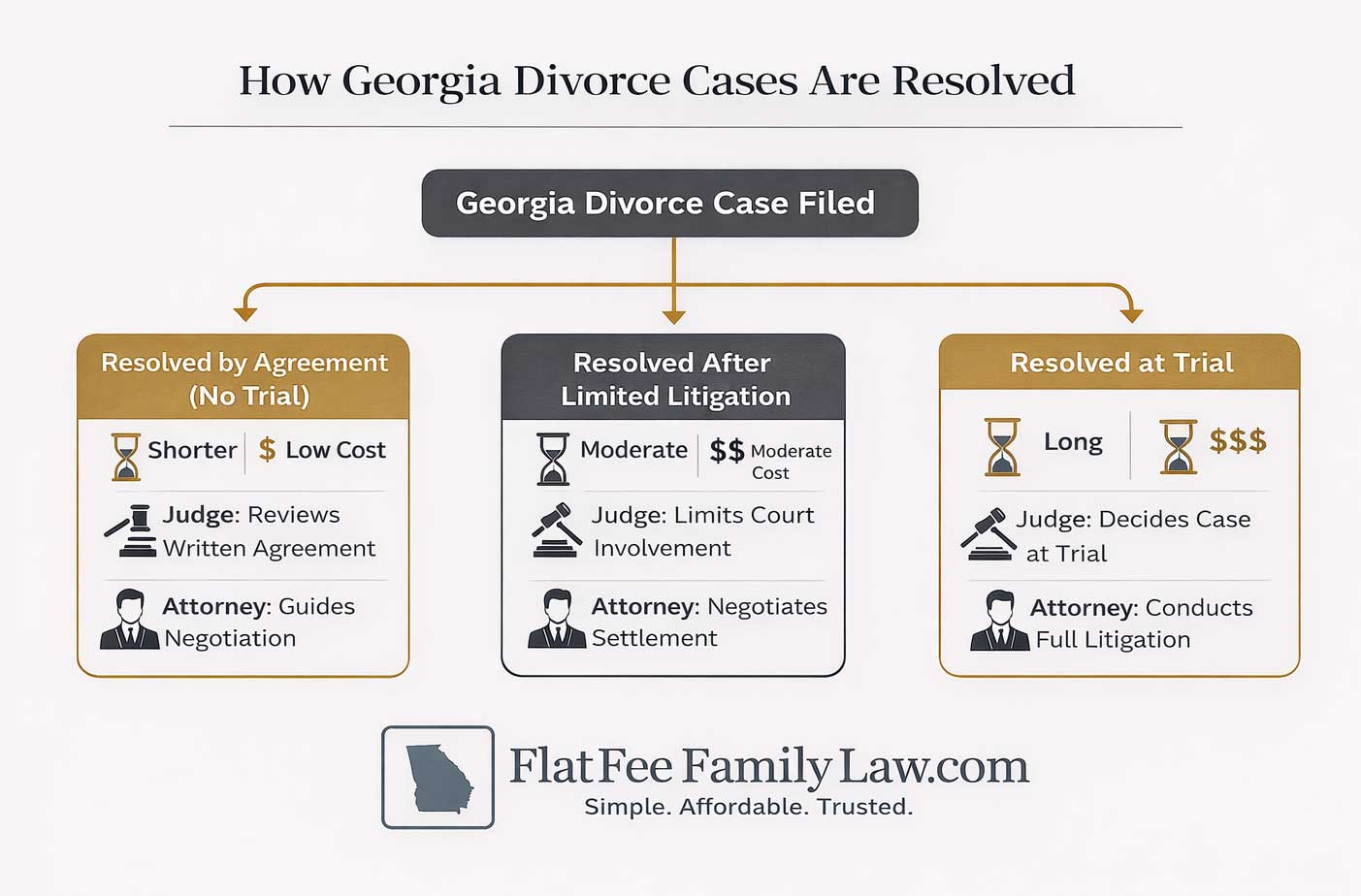
In fact, many divorce cases — including those that start with disagreement — are resolved without ever going to trial. That doesn’t mean they’re simple or stress free. It means the case reached resolution through agreement rather than litigation.
Understanding when a Georgia divorce can be resolved without a trial helps you make informed decisions early, manage expectations, and avoid unnecessary conflict and expense.
Below, we explain what “resolving a divorce without trial” really means, when it’s possible, and why attorney guidance still plays a critical role — even when court litigation is avoided.
What Does “Resolved Without a Trial” Mean in Georgia?
A divorce resolved without a trial means:
- The spouses reach agreement on all required matters
- The judge is not asked to decide disputed issues
- The court’s role is limited to review and approval, not fact-finding
This often results in:
- Shorter hearings
- Fewer court appearances
- Less emotional and financial strain
Importantly, resolving a divorce without a trial does not mean avoiding the court entirely. Georgia divorces still require proper filings, judicial review, a final order signed by a judge — these generally happen during court-managed hearings, but not a trial.
Most Georgia Divorces Do Not End in Trial
Trials are generally the exception, not the rule.
Many cases resolve before trial because:
- Potential issues that may require trial become clearer over time
- Temporary orders create structure
- Negotiations narrow disputes
- Both sides reassess priorities and costs
This is true in both uncontested divorces and many contested cases that later settle.
Situations Where a Divorce Can Be Resolved Without Trial
A Georgia divorce can typically be resolved without trial when:
1. Both Spouses Reach Full Agreement
This includes agreement on:
- Property and debt division
- Alimony (if applicable)
- Child custody and parenting time (if children are involved)
- Child support and expenses
Courts cannot finalize a divorce without trial unless all issues are resolved.
2. Disputes Are Narrow and Resolved Early
Some cases begin with disagreement but resolve once:
- Financial information is exchanged
- Parenting schedules are clarified
- Expectations are reset and both parties are in full agreement on terms of settlement
When disputes are resolved before final hearing, trial becomes unnecessary.
3. Temporary Orders Reduce Conflict
Temporary custody or support orders often stabilize a situation and:
- Reduce uncertainty
- Provide structure
- Encourage resolution
Once both parties understand how the court is likely to approach issues, settlement becomes more achievable.
4. Both Parties Prioritize Resolution Over Litigation
Trials are time-consuming, expensive, and emotionally draining.
Many spouses decide that:
- Certainty is better than prolonged conflict
- Resolution matters more than “winning”
- Control over outcomes is preferable to judicial decisions
That mindset shift often opens the door to agreement.
Situations When A Trial Is Still Necessary
A divorce generally cannot be resolved without trial when:
- One party refuses to negotiate
- Critical facts are disputed
- Safety concerns exist
- Custody disputes remain unresolved
- One spouse will not comply with court orders
In those cases, trial may be unavoidable — and appropriate.
Resolving without trial is not about avoidance; it’s about whether resolution is realistically achievable.
Does Resolving Without Trial Mean You Don’t Need an Attorney?
No — and this is a common misconception.
Even when a divorce is resolved without trial:
- Legal rights are still being permanently decided
- Agreements must comply with Georgia law
- Court filings must be accurate and complete
- Errors can delay finalization or create future disputes
Attorney involvement helps ensure:
- Agreements are enforceable
- Parenting plans are properly structured
- Financial terms are clear and complete
- The court can approve the resolution without issue
Avoiding trial does not mean navigating the process alone.
Why Flat-Fee Representation Works Well for Non-Trial Resolutions
When a case is resolved without trial, predictable pricing matters.
Flat-fee representation offers:
- Cost certainty
- No incentive to prolong the case
- Clear scope of work
- Attorney-prepared filings and agreements
At Flat Fee Family Law.com, we focus on efficient, attorney-led resolution — whether a case is uncontested from the start or resolved before trial becomes necessary.
Key Takeaway: Resolution Without Trial Is Strategic — Not Accidental
Divorces don’t avoid trial by luck.
They avoid trial through:
- Informed decision-making
- Clear expectations
- Proper legal guidance
- Strategic resolution
Knowing when trial can be avoided — and when it cannot — helps you choose the right path forward with clarity and confidence.
Does avoiding trial make divorce faster?
Often, yes — but timelines still depend on court scheduling and proper filings.
Will a judge still review our agreement?
Yes. Judges must review and approve all divorce resolutions.
Can a divorce avoid trial if children are involved?
Is resolving without trial always cheaper?
Generally, but only if the agreement is properly handled the first time.
Get Guidance on the Right Path for Your Case
Every divorce is different. Some require litigation. Many do not.
Understanding whether your Georgia divorce can be resolved without trial — and how to do so correctly — starts with informed legal guidance.
Learn more about uncontested divorce representation in Georgia and schedule a flat-fee consultation with our Attorney at Flat Fee Family Law.com
Attorney-led. Flat-fee. No surprises.