
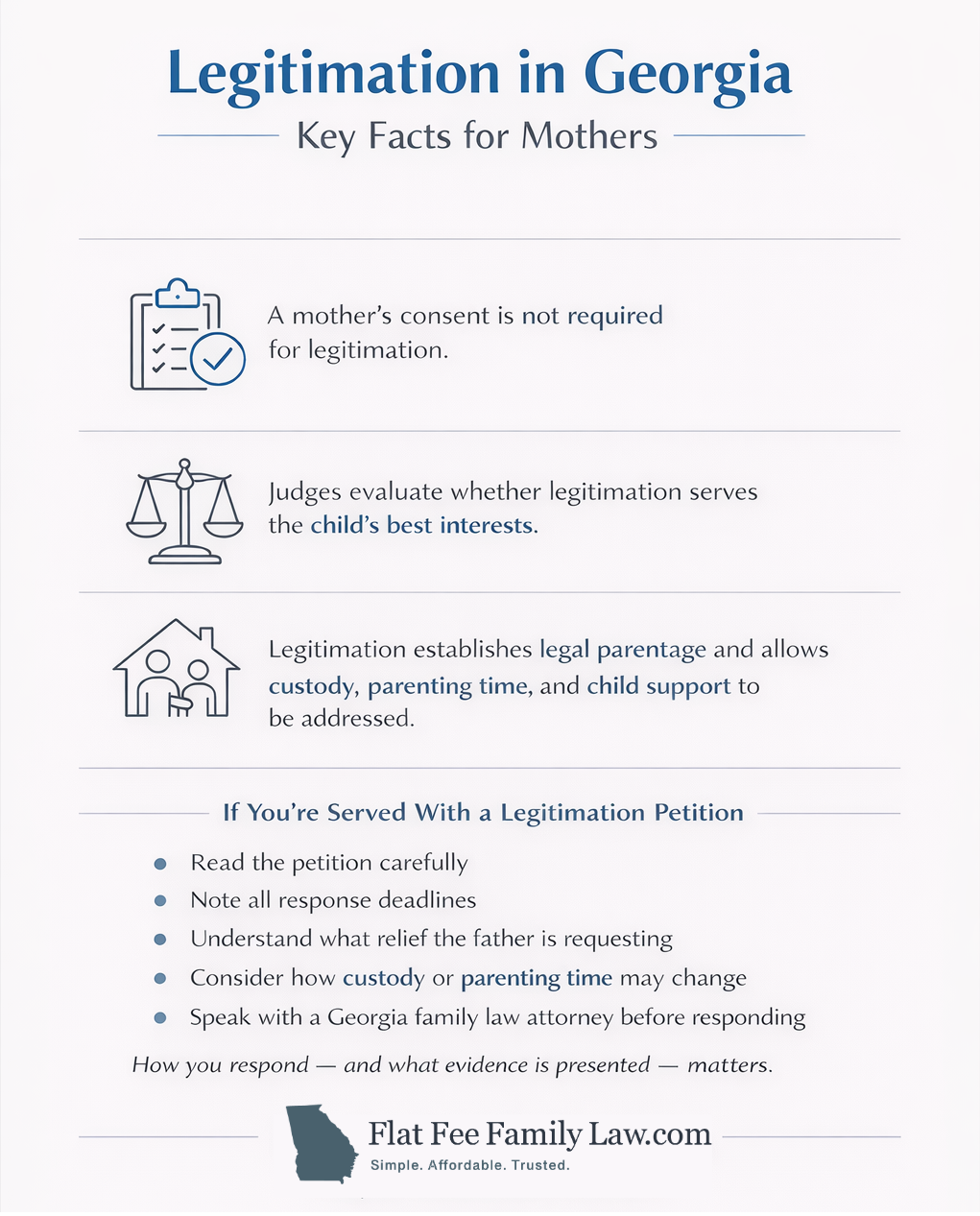
Legitimation Raises Real Questions for Mothers
In Georgia, legitimation is the legal process that allows a biological father to establish parental rights to a child born outside of marriage. While fathers often initiate legitimation, mothers are frequently the ones asking an important question:
Do I have to agree to legitimation — or can a judge approve it even if I object?
The short answer is: A mother’s consent is not always required for legitimation to be granted by a judge.
Georgia courts can grant legitimation over a mother’s objection if the judge determines that legitimation is in the child’s best interests. Because of this possible outcome, it is especially important for mothers to understand how the process works, what factors the courts consider, and how to protect their child’s interests throughout the case.
This guide explains what Georgia law actually says — and what mothers should know before responding to a legitimation action.
What Is Legitimation in Georgia?
Under Georgia law, a biological father does not automatically have parental rights to a child born outside of marriage — even if his name appears on the birth certificate.
Legitimation is the legal process that:
- Establishes the father as the child’s legal parent
- Allows the father to seek custody or parenting time
- Enables the court to enter enforceable custody and visitation orders
Without legitimation:
- The mother generally retains sole legal custody
- The father may still be legally obligated to pay child support
- The father has limited ability to seek custody or visitation
Does a Mother Have to Agree to Legitimation?
No. A mother’s consent is not required for legitimation to be granted in Georgia.
If a father files a legitimation petition and the mother objects, the court does not automatically deny the request. Instead, the judge evaluates whether legitimation would serve the best interests of the child.
That means a legitimation case can succeed even if the mother does not agree.
When Mothers Do Consent to Legitimation
In some cases, mothers consent to legitimation because:
- The father has been consistently involved
- The parents already share parenting responsibilities
- Legitimation will help formalize an existing arrangement
- The mother wants court-ordered child support tied to custody
When both parents agree, legitimation cases often move more efficiently and with less conflict.
However, consent should never be automatic. Mothers should understand what legitimation actually changes before agreeing — especially regarding custody, decision-making authority, and future litigation risk.
When a Judge Can Grant Legitimation Over a Mother’s Objection
If a mother objects, the court looks at whether legitimation is in the child’s best interests.
Georgia courts commonly evaluate factors such as:
- The father’s involvement in the child’s life
- Whether the father provides financial support
- The stability and safety of the father’s home
- The child’s emotional and physical well-being
- The nature of the parents’ relationship and communication
- Any history of abuse, neglect, or substance issues
A judge may grant legitimation if the evidence shows that recognizing the father as a legal parent would benefit the child — even if the mother disagrees.
When a Mother’s Objection Carries More Weight
While consent is not required, a mother’s objection is taken seriously — especially when supported by evidence.
Courts may be more hesitant to grant legitimation when:
- The father has had little or no contact with the child
- The father failed to provide support despite knowing of the child
- There are documented safety concerns
- The father’s involvement would destabilize the child’s environment
- The legitimation request appears retaliatory or strategic
Each case is unique, and mothers are not expected to simply accept legitimation without legal scrutiny.
How Legitimation Affects Custody and Parenting Time
This is often the most important issue for mothers.
Legitimation alone does not automatically grant custody to the father. However, once legitimation is established:
- The father may seek joint or primary custody
- The court may enter a formal parenting plan
- Decision-making authority may be shared
For mothers who have been the child’s primary caregiver, this can represent a significant legal shift — which is why responding to petitions for legitimation strategically matters.
Child Support and Legitimation: What Changes?
Legitimation often goes hand-in-hand with child support.
Once legitimation is established:
- Courts can issue enforceable child support orders
- Support calculations follow Georgia guidelines
- Support may be retroactive in some cases
Importantly, a mother’s objection to legitimation does not eliminate child support obligations. Fathers can be ordered to pay support even if legitimation is denied.
What Mothers Should Do If Served With a Legitimation Petition
If you are served with legitimation papers, do not ignore them.
Mothers should:
- Read the petition carefully
- Note all response deadlines
- Understand what relief the father is requesting
- Consider how legitimation would affect custody and parenting time
- Speak with a Georgia family law attorney before responding
Even when a mother believes legitimation should not be granted, how she responds — and what evidence is presented — matters.
How Flat Fee Family Law.com Helps Mothers in Legitimation Cases
Legitimation cases are not one-size-fits-all. At Flat Fee Family Law.com, we help mothers:
- Understand whether consent is legally required
- Evaluate the risks and benefits of legitimation
- Respond appropriately to legitimation petitions
- Protect custody rights and parenting authority
- Navigate court proceedings with clarity and predictability
Our flat-fee, attorney-led approach ensures mothers know:
- The scope of representation upfront
- The total cost before proceeding
- Who is handling the case at every stage
Final Thoughts
Whether you are considering consenting to legitimation or responding to a petition you oppose, getting clear legal guidance early can help you protect your child — and avoid unintended consequences.
If you’ve been served with a legitimation action or have questions about your rights as a mother, schedule a call with an experienced Georgia family law attorney at Flat Fee Family Law.com can help you make informed decisions with confidence.
Do mothers have to consent to legitimation in Georgia?
No. A judge may grant legitimation without the mother’s consent if it is in the child’s best interests.
Does legitimation automatically give the father custody?
No. Legitimation establishes legal parentage, but custody is decided separately.
Can a mother object to legitimation?
Yes. Mothers can object and present evidence showing why legitimation would not benefit the child.
Does child support require legitimation?
No. Fathers may owe child support even if legitimation is denied.