
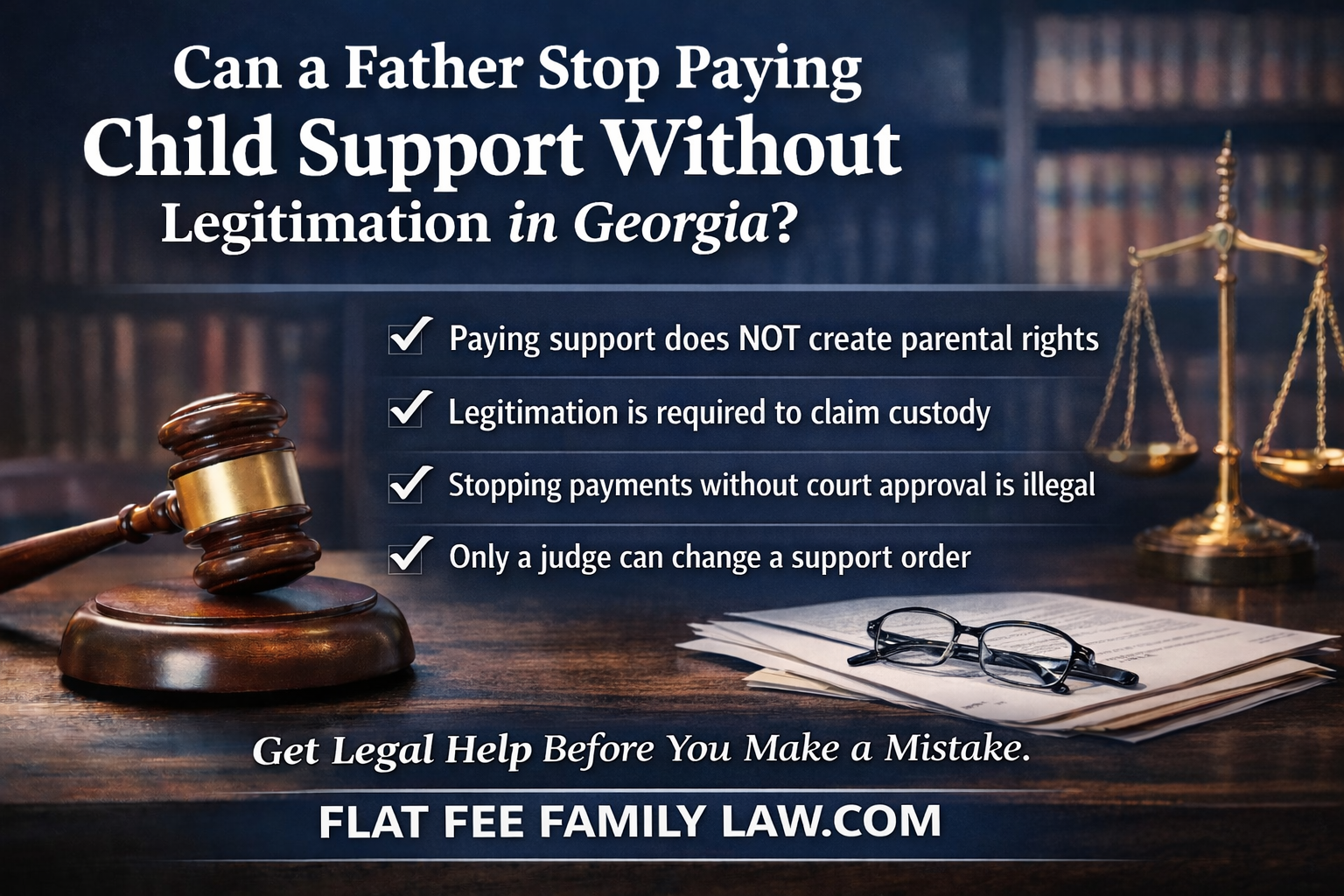
Can a Father Stop Paying Child Support Without Legitimation in Georgia?
If you’re a father in Georgia paying child support and wondering whether you can stop — or change — those payments without filing for legitimation, the short answer is:
No.
In most cases, a father cannot legally stop paying child support in Georgia without legitimation or a court order modifying support.
Understanding why this is true — and what legitimation actually changes — is critical if you want to protect your parental rights and avoid serious legal consequences.
The short answer (up front)
Under Georgia law:
- Child support orders remain enforceable until a court modifies them
- Paying support does not automatically give a father parental rights
- Legitimation is the legal process that establishes a father’s rights, including custody and visitation
- Stopping payments without court approval can result in contempt, wage garnishment, and arrears
If you want child support reviewed, reduced, or terminated — you must go through the court.
Why paying child support does not give fathers parental rights in Georgia
This is one of the most misunderstood areas of Georgia family law.
In Georgia, when a child is born to unmarried parents:
- The mother automatically has sole legal and physical custody
- The father has no enforceable parental rights until legitimation
Even if the father:
- is listed on the birth certificate
- voluntarily pays child support
- is involved in the child’s life
None of those actions replace legitimation.
So while the court can require a father to pay child support, that obligation exists independently of parental rights.
What legitimation actually does (and why it matters)
Legitimation is the legal process that allows a father to:
- Establish legal parent-child status
- Seek custody or visitation
- Participate in major decisions about the child
- Ask the court to review child support fairly
Without legitimation, the court may still order child support — but the father has limited legal standing to challenge custody or visitation arrangements.
In other words:
Legitimation doesn’t automatically stop child support — but it gives fathers the legal footing to address it properly.
Can child support ever stop without legitimation?
There are very limited circumstances where child support may end — but none involve simply deciding to stop paying.
Examples include:
- The child reaches age 18 (or 20 if still in high school)
- The court terminates the support order
- The child is legally adopted
- The court approves a modification or termination
Even in these situations, a court order is required.
Stopping payments on your own — even temporarily — can lead to:
- Contempt of court
- Accumulated arrears (with interest)
- License suspension
- Wage garnishment
- Jail time in serious cases
Legitimation vs. child support modification: what’s the difference?
This is an important distinction.
Legitimation
- Establishes parental rights
- Allows the father to request custody or visitation
- Does not automatically reduce or stop support
- Is often the first step toward a fairer arrangement
Child support modification
- Changes the amount of support
- Requires proof of:
- changed income
- changed parenting time
- changed circumstances
- Must be approved by the court
In many cases, fathers pursue both:
- Legitimation to establish rights
- Modification to adjust child support based on custody or income
Why fathers get into trouble trying to “self-help”
Many fathers stop paying support because they believe:
- the amount is unfair
- they aren’t allowed to see their child
- the mother isn’t following an agreement
- they’re paying voluntarily without rights
Unfortunately, Georgia courts do not accept these reasons as justification for nonpayment.
From the court’s perspective:
- Child support and visitation are separate issues
- One does not excuse the other
- Only a judge can change an order
Trying to handle this informally often makes the situation worse — and more expensive to fix later.
How legitimation can help fathers long-term
While legitimation alone doesn’t cancel child support, it can:
- Lead to shared custody or visitation
- Provide grounds for support recalculation
- Prevent one-sided decision-making
- Protect the father’s role in the child’s life
For many fathers, legitimation is not about avoiding responsibility — it’s about having rights alongside responsibilities.
Flat-fee legitimation in Georgia: clarity matters
Legitimation cases can feel intimidating, especially if you’re already paying support. Uncertainty around cost keeps many fathers stuck.
At Flat Fee Family Law.com, we offer:
- Clear, flat-fee pricing
- Legitimation services tailored to fathers
- Guidance on how legitimation interacts with child support
- No surprise hourly billing
Our goal is to help fathers take the right legal steps, not risky shortcuts.
The bottom line for Georgia fathers
- You cannot legally stop paying child support without a court order
- Paying support alone does not give parental rights
- Legitimation is often the first step toward fairness
- Acting without court approval can create serious legal problems
If you’re considering legitimation — or questioning your current child support obligation — it’s important to get accurate legal guidance before making a move.
Ready to talk about legitimation?
If you’re a father in Georgia and want to understand your rights, options, and costs before filing, schedule a call with Flat Fee Family Law, lets see if we can help.
Clear pricing. Clear guidance. No surprises.
Frequently Asked Questions (FAQ)
Can I stop paying child support if the mother agrees?
No. Even if both parents agree informally, only a court order can change child support. Informal agreements are not enforceable.
Does legitimation automatically reduce child support?
No. Legitimation establishes rights, but child support must be modified separately if a change is appropriate.
What if I’m paying support but can’t see my child?
Unfortunately, lack of visitation does not excuse nonpayment. Legitimation is often the correct legal path to address this issue.
Can I file for legitimation if I’m behind on child support?
Yes. Owing support does not prevent legitimation, but arrears remain enforceable unless addressed by the court.
How long does legitimation take in Georgia?
Timelines vary, but most cases take several months, depending on whether the case is contested and whether custody issues are involved.
Do I need a lawyer to file for legitimation?
You are not required to have a lawyer, but legitimation affects long-term parental rights. Mistakes can be difficult to undo later.