How Child Support Is Actually Calculated in Georgia (2026 Guide)
Understanding How Child Support Really Works in Georgia
If you’re going through a divorce, custody, or legitimation case in Georgia, child support is going to be part of the process. But here’s where most people get it wrong, they assume child support is:
- a fixed percentage
- something a judge decides based on fairness
- or something that can be negotiated freely
It’s none of those.
Georgia uses a structured formula to calculate child support that produces a probable number. And in most cases, that number is what the court will use. What matters—and what actually drives outcomes—is how that number gets built.
The Framework: Georgia’s Income Shares Model
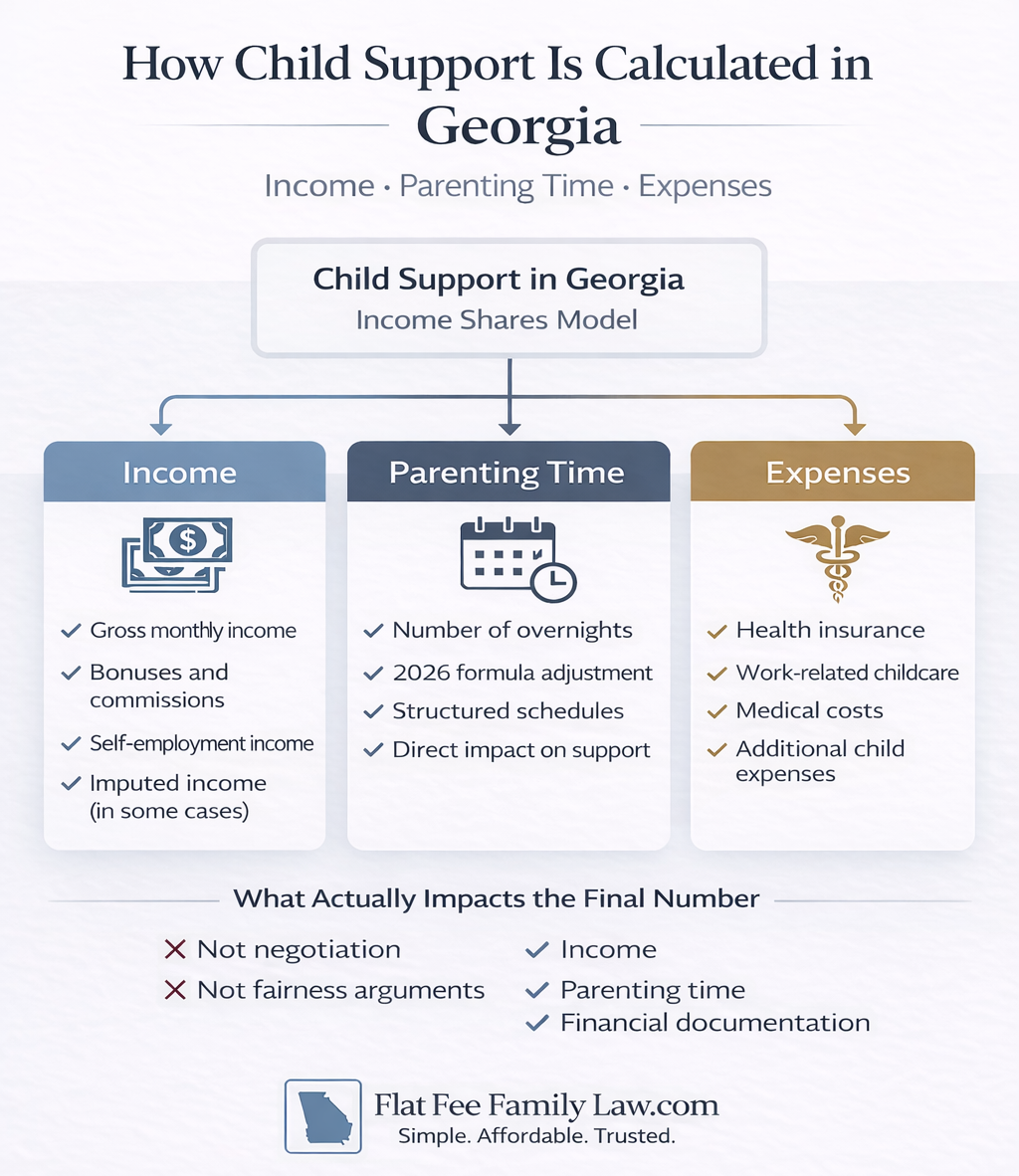
Georgia calculates child support under O.C.G.A. § 19-6-15 using what’s called the Income Shares Model. At a high level, the court is trying to answer one question, what would both parents be spending on the child if they were still in the same household?
That combined responsibility is then divided between the parents based on their income. This is why both parents’ incomes matter, not just the person paying support and not just who has custody.
What Actually Goes Into the Calculation
On paper, the formula looks straightforward. In practice, most of the issues come from what gets included—and how it’s presented.
Individual Income
The calculation starts with each parent’s gross monthly income. But “income” is broader than most people expect. It can include:
- Salary and wages
- Bonuses and commissions
- Self-employment income
- Rental or investment income
- Retirement or disability benefits
And in some cases, the court can assign an income to a parent who is unemployed or underemployed (imputed income).
Combined income
Once both incomes are established, they are combined. That total is used to determine the baseline support obligation from a statutory table. This is a key point:
- The number doesn’t come from negotiation
- It doesn’t come from what feels reasonable
- It comes from a guideline tied directly to income
Additional expenses
After the base amount is determined, the calculation adjusts for real-world costs, such as:
- Health insurance for the child
- Work-related childcare
- Medical or educational expenses
These can significantly change the final number, especially in cases involving younger children or two working parents.
Parenting time (the big change in 2026)
One of the most important updates is how parenting time is handled. As of January 1, 2026, Georgia uses a formula-based parenting time adjustment, rather than treating it as a discretionary factor. That means:
- The number of overnights now directly impacts support
- The parenting time adjustment is now calculated—not argued before the court
- Parenting schedules can materially change the result
This is often misunderstood and can have a larger impact than people expect.
Where Child Support Cases Are Actually Decided
Most people assume child support disputes are about the formula. They’re not. The formula is consistent. What actually drives outcomes is what goes into it.
Income disputes
Questions about what someone earns—or should be earning—can significantly shift the calculation. This includes the potential court assigned imputed income to unemployed, or underemployed, parents.
Parenting time structure
Not just how much time each parent has, but how it’s structured across the year.
Expense inclusion
Whether certain costs are included, excluded, or allocated differently.
Financial documentation
Accurate and complete financial disclosures—especially the Domestic Relations Financial Affidavit (DRFA)—play a major role in how these numbers are determined.
Can the Court Deviate from the Formula?
The calculated number is considered the probable amount. Courts can deviate—but not casually. They must:
- Provide a written justification
- Show that the deviation is in the child’s best interest
In practice, most cases stay close to the guideline amount unless there is a clear reason not to.
Common Misconceptions About Child Support
“It’s based on custody”
Custody affects parenting time, but income remains the primary driver.
“It’s negotiable”
Agreements are possible, but courts still review them against the guideline calculation.
“It’s a percentage of income”
That’s true in some states—but not in Georgia.
“If I earn less, I automatically pay less”
Only if the court accepts that income as accurate and reasonable.
How This Connects to the Rest of Your Case
Child support doesn’t exist in isolation. It ties directly into:
- Parenting plans
- Custody arrangements
- Financial disclosures
- Final hearing preparation
If those pieces aren’t aligned, the child support calculation won’t reflect the full picture.
Final Thoughts
Georgia’s child support system is structured—but it’s not always intuitive. It’s built on:
- Combined income
- Proportional responsibility of parenting time
- Actual child-related expenses
Once you understand how those pieces fit together, you can better anticipate outcomes—and avoid common mistakes that affect the final number.
Questions About How Child Support Applies to Your Case?
Understanding how child support is calculated is one thing. Applying it to your specific situation—especially when income, parenting time, or expenses are disputed—is where things become more complex.
If you have questions about how child support may be calculated in your case, or how different factors could impact the outcome, you can schedule a call to discuss your situation.
Flat Fee Family Law represents clients across Georgia in divorce, custody, and legitimation cases, including those involving child support determinations and final hearings.
Schedule a consultation with our attorney, Brendan Dalton, to discuss your situation and next steps and learn how Flat Fee Family Law can support you in your family law matter.
Frequently Asked Questions
How is child support calculated in Georgia?
Georgia uses an income shares model that combines both parents’ incomes, applies a guideline table, and adjusts for expenses and parenting time.
Does parenting time affect child support in Georgia?
Yes. As of 2026, parenting time is incorporated into the formula and can directly impact the support amount.
What income counts for child support?
Most income sources are included, including wages, bonuses, self-employment income, and certain benefits.
Can child support be different from the guideline amount?
Yes, but courts must justify any deviation and show it serves the child’s best interest.
When can child support be modified?
When there is a substantial change in income, parenting time, or the child’s needs.