How Parenting Plans Actually Work in Georgia Custody Cases
Understanding Parenting Plans in Real Life — Not Just on Paper
If you are going through a divorce, custody case, or legitimation in Georgia, you will be required to create a parenting plan. Many people approach this as a formality. Courts do not.
A parenting plan is not just something filed with the court — it is the document that will govern how parents raise their child moving forward. It becomes part of the final order and controls day-to-day expectations, decision-making, and parenting time.
If you have not already reviewed the basics of parenting plans in Georgia, you may start with our full guide here: Parenting Plans in Georgia | Custody & Family Law. This guide focuses on how parenting plans actually function in real cases.
What a Parenting Plan Actually Does
At its core, a parenting plan answers one question: How will these parents raise their child after the case is over? It goes beyond simply outlining a schedule. A complete parenting plan addresses:
- Where the child lives (physical custody)
- Who makes major decisions (legal custody)
- How parenting time is shared
- How disagreements are handled
Parenting plans are required in any case involving custody, including divorce, legitimation, and custody and modification actions. Regardless of how a case begins, the parenting plan ultimately governs custody, parenting time, and decision-making.
The Two Parts Most People Focus On (And Why That Is Not Enough)
Most parents focus on two components:
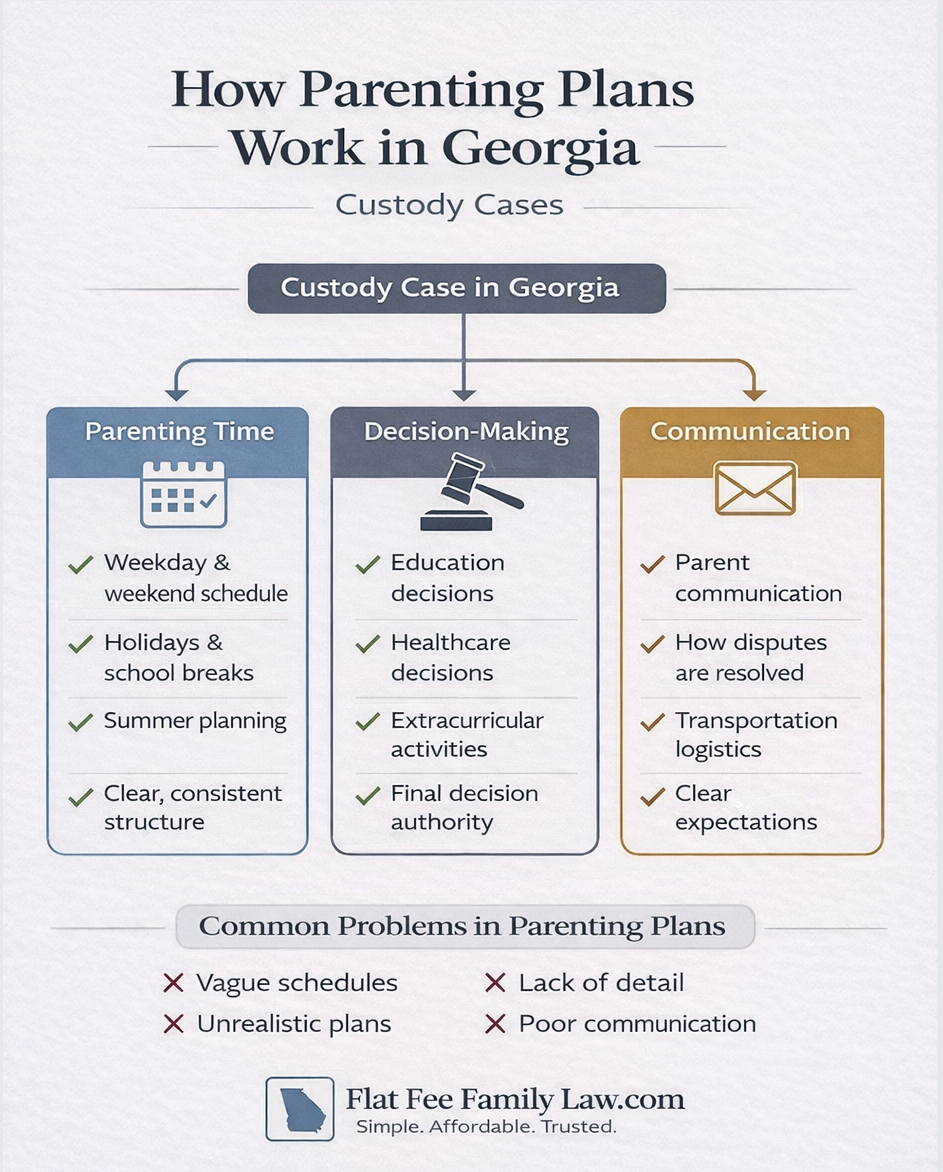
- Parenting Time (The Schedule) – ambiguity creates conflict so these elements must be clear and specific:
- Weekday and weekend structure
- Holidays and school breaks
- Summer schedules
- Legal Custody (Decision-Making) – parents may share decision-making, or one parent may have final authority if there is a disagreement. Legal custody addresses major decisions involving:
- Education
- Healthcare
- Extracurricular activities
- Religion
What Is Often Overlooked
The schedule and decision-making structure are only the foundation. Many conflict arise from the details that are not fully addressed.
What Judges Actually Look for in a Parenting Plan
Courts are not focused on what feels fair between parents. The focus is on what serves the child’s stability and well-being. A strong parenting plan demonstrates:
- Stability – the plan should provide:
- Consistent routines
- Predictable transitions
- Minimal disruption to the child’s daily life
- Specificity – vague language often leads to future disputes. Phrases such as “as agreed between the parties” tend to create conflict rather than prevent it. Courts prefer clear, enforceable terms.
- Practicality – a parenting plan must be workable in real life. A plan that cannot be followed consistently will not serve the child or either parent. It should account for:
- Work schedules
- School schedules
- Distance between homes
- Communication Structure – the plan should address:
- How parents communicate
- How decisions are made
- How disagreements are resolved
A well-structured plan reduces the likelihood of returning to court.
How Parenting Plans Are Created in Georgia
Parenting plans are typically created in one of two ways:
Agreement Between Parents
When parents agree on a plan, they may submit it to the court. Courts generally approve agreed-upon plans if they are clear and support the child’s stability.
Disagreement Between Parents
If parents cannot agree, each parent submits a proposed plan and the judge determines the final structure. The court may adopt one plan, combine elements of both, or establish its own framework.
Common Mistakes That Lead to Problems
Several recurring issues tend to create unnecessary conflict:
- Lack of detail that leads to ongoing disagreements
- Focusing on winning rather than creating a workable structure
- Ignoring logistics, including transportation and timing
- Overcomplicating the plan, making it difficult to follow
The goal is to create a plan that is clear, practical, and sustainable.
Why Parenting Plans Matter
While many people focus on the concept of “custody,” it is the parenting plan that determines how that custody operates in practice. It defines:
- Where the child lives
- How time is shared
- Who makes decisions
- How issues are handled
Once entered, the parenting plan remains in effect unless modified by the court.
Final Takeaway
A parenting plan is not simply a required document — it is the structure of the co-parenting relationship moving forward. The most effective plans are:
- Clear
- Specific
- Practical
- Focused on the child’s stability
These are the factors courts consider, and they are often what determine how smoothly things function after the case is resolved.
Schedule a Call to Discuss Your Parenting Plan
If you are involved in a custody case, divorce, or legitimation, your parenting plan will play a central role in the outcome.
Our attorney at Flat Fee Family Law works with clients across Georgia to develop clear, practical parenting plans that reflect how courts actually approach these decisions.
Schedule a call today to discuss your situation and next steps.
Frequently Asked Questions
Are parenting plans required in Georgia?
Yes. A parenting plan is required in all cases involving custody and must be included in the final order.
Can parents agree on a parenting plan that is submitted to the court for consideration?
Yes. If both parents agree, they may submit a plan for court approval.
What happens if parents cannot agree?
Each parent submits a proposed plan, and the judge determines the final arrangement.
Can a parenting plan be modified?
Yes, but only if there is a significant change affecting the child that justifies modification.