
What to Expect at a Georgia Divorce Hearing (From a Judge’s Perspective)
When people think about a divorce or legitimation hearing, they often picture a dramatic courtroom moment like they’ve seen on tv. That is not how most hearings actually work.
Georgia judges are not starting from zero when they walk into your case. They are reviewing filings, looking for key issues, and trying to make efficient, legally sound decisions based on the facts presented. Most hearings are focused, time-limited, and centered on a few specific questions.
Understanding what matters to the judge — and what does not — can make a significant difference in how your case is presented and ultimately decided. This guide explains how judges typically approach divorce of legitimation hearings in Georgia and what they are really paying attention to when making decisions.
What a Judge Is Actually Trying to Do
At a high level, a judge in a divorce case is focused on three things:
- Applying Georgia law correctly
- Resolving disputed issues efficiently
- Reaching a fair and workable outcome based on the evidence
Judges are not there to referee personal disputes or assign moral blame. They are not interested in who was the better spouse or who “started it.” Their role is to make decisions within the framework of the law. That means the most persuasive cases are the ones that stay focused on relevant legal issues, not emotional narratives.
The Issues Judges Focus on Most
Every divorce or legitimation case is different, but most hearings in Georgia revolve around a core set of issues.
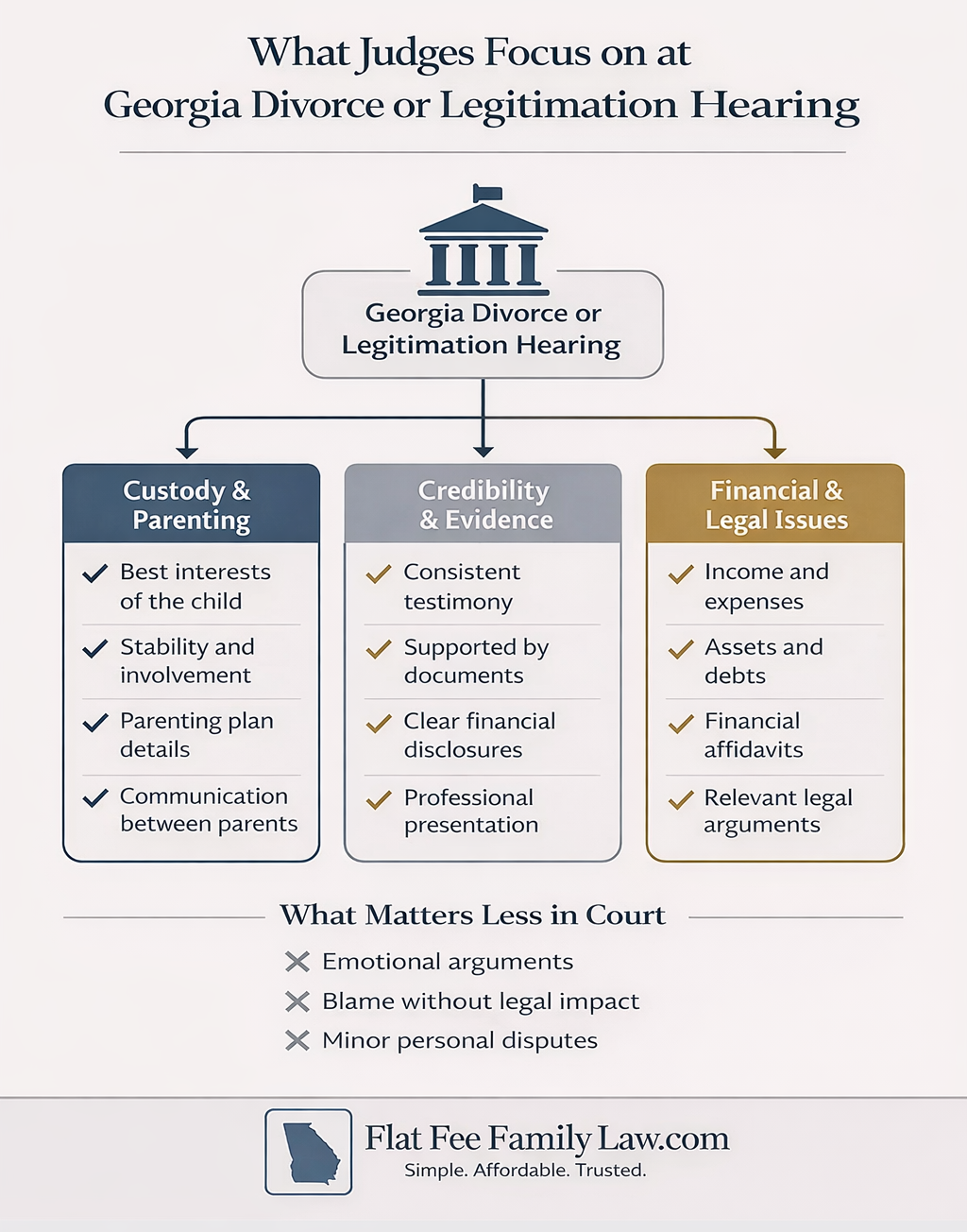
1. Custody and Parenting Time
If children are involved, this is often the most important part of the case. Judges are required to base custody decisions on the best interests of the child. That includes evaluating factors such as:
- Each parent’s involvement in the child’s life
- Stability of each household
- Ability to meet the child’s needs
- Communication between parents
- Any history of family violence or substance abuse
What matters here is not what a parent says they plan to do — it is what they have already been doing. Judges look for patterns, consistency, and credibility. Parents who present clear, practical parenting plans tend to be taken more seriously than those who focus on criticizing the other parent.
2. Financial Transparency
In almost every divorce hearing, financial issues play a central role. This includes:
- Income from all sources
- Monthly expenses
- Assets and debts
- Bank accounts, retirement accounts, and property
Judges rely heavily on financial affidavits and supporting documents. If the numbers are unclear, inconsistent, or unsupported, it creates problems. One of the fastest ways to lose credibility in a divorce hearing is to appear evasive or inaccurate about finances. On the other hand, clear and organized financial information helps the judge make decisions more efficiently and often works in your favor.
3. Credibility of Each Party
Judges are constantly evaluating credibility. They are watching for:
- Consistency between testimony and documents
- Whether answers are direct or evasive
- Whether claims are supported by evidence
- Overall demeanor and professionalism
Credibility often matters more than people realize.
Two parties can present very different versions of the same situation. The judge has to decide which version is more reliable. That decision can influence everything from custody to financial outcomes.
4. Ability to Reach Reasonable Agreements
Judges strongly prefer when parties can resolve issues without court intervention. Even during a hearing, judges are often assessing:
- Whether a party is being reasonable
- Whether positions are realistic
- Whether compromise is possible
If one side appears rigid or unwilling to negotiate on anything, that can work against them. Judges are more likely to respond favorably to parties who show flexibility and a willingness to find workable solutions.
5. Focus on Relevant Issues
Time in court is limited. Judges expect parties and attorneys to focus on what actually matters to the legal issues in the case. That means:
- Staying on topic
- Avoiding unnecessary detail
- Not introducing irrelevant personal complaints
Bringing up issues that do not affect custody, finances, or legal rights can distract from stronger arguments. The most effective presentations are clear, organized, and focused.
What Judges Do Not Care About (As Much As People Think)
This is where many people get it wrong.
Fault in the Marriage
While Georgia does recognize fault-based divorce, most hearings are not focused on who caused the marriage to end. Issues like infidelity or personal disagreements typically do not carry as much weight unless they directly impact finances or children.
Emotional Arguments
It is completely normal to feel emotional during a divorce. But in a courtroom setting, emotional arguments without supporting facts are not persuasive. Judges are looking for evidence, not intensity.
Minor Disputes
Arguments over small personal issues often do more harm than good in a hearing. Judges are focused on decisions that have real legal impact. Spending time on minor grievances can make a case appear unfocused.
How Judges Prepare Before the Hearing
Many people assume the hearing is the first time a judge learns about the case. That is rarely true. Before the hearing, judges typically review:
- Pleadings (complaints, answers, counterclaims)
- Motions filed by either party
- Financial affidavits
- Proposed parenting plans
This means first impressions are often formed before anyone speaks in court. If your filings are clear, organized, and consistent, you are already starting from a stronger position.
What Happens During the Hearing
While every courtroom is different, most divorce hearings in Georgia follow a similar structure:
- Each side presents their case
- Testimony is given under oath
- Documents and evidence are introduced
- The judge may ask questions directly
- Arguments are made about the legal issues
Some hearings are short and focused. Others can be more detailed depending on the complexity of the case. In many situations, the judge may not issue a decision immediately. Instead, they may take the matter under advisement and issue a written order later.
Practical Ways to Align with What Judges Want
If you step back, a pattern becomes clear. Judges are not looking for perfection. They are looking for clarity, credibility, and efficiency. Here are a few practical ways to align your case with that perspective:
- Keep your arguments focused on legal issues
- Make sure your financial information is accurate and complete
- Be consistent in what you say and what your documents show
- Avoid exaggeration or unsupported claims
- Stay professional, even if the situation is stressful
- Be open to reasonable compromise where appropriate
These are simple ideas, but they are often what separates strong cases from weaker ones.
Why This Perspective Matters
Most people approach a divorce or legitimation hearing from their own point of view. That is natural, but it can also be limiting. When you understand how a judge is viewing the case, you can adjust your approach in a way that is more effective. You are no longer just telling your story — you are presenting information in a way that helps the judge make a decision. That shift can have a real impact on outcomes.
Final Thoughts
A Georgia divorce or legitimation hearing is not about who tells the most compelling personal story. It is about presenting clear, credible, and relevant information that allows a judge to apply the law and resolve the issues in the case.
When you understand what matters from the judge’s perspective, you can approach the process with more focus and less uncertainty. And in a process that can often feel overwhelming, that clarity makes a difference.
Ready to Take the Next Step?
If you are preparing for a divorce or legitimation hearing — or trying to understand what to expect — it helps to have clear guidance from attorneys who handle these cases every day.
At Flat Fee Family Law.com, our attorney has worked with hundreds of clients across Georgia in divorce, custody, child support, and legitimation matters. Our approach is simple: clear advice, transparent pricing, and a process designed to move your case forward efficiently.
Schedule a consultation to get answers to your questions and understand your options.
Frequently Asked Questions
What does a judge look for most in a divorce hearing?
Judges focus on a few key areas: the best interests of the child (if custody is involved), accurate financial information, credibility of each party, and whether positions are reasonable and supported by evidence. Clear, organized presentations tend to carry more weight than emotional arguments.
How can I prepare for a divorce hearing in Georgia?
Preparation typically includes reviewing your financial affidavit, organizing supporting documents, and understanding the specific issues being decided at the hearing. It is also important to be clear, consistent, and focused on relevant facts rather than personal disputes.
How long does a divorce hearing take in Georgia?
Many hearings are relatively short and focused, sometimes lasting less than an hour. However, more complex cases involving custody or financial disputes may take longer depending on the issues involved and the court’s schedule.
Do judges read documents before the hearing?
Yes. In most cases, judges review pleadings, motions, and financial affidavits before the hearing begins. That means your written filings often shape the judge’s initial understanding of the case.
What should I not say during a divorce hearing?
It is generally best to avoid exaggerations, unsupported claims, or bringing up issues that are not legally relevant. Emotional arguments without evidence can distract from stronger points and may impact credibility.
Does fault (like cheating) matter in a Georgia divorce hearing?
In most hearings, fault is not the primary focus unless it directly affects financial issues or the well-being of a child. Judges are typically more focused on resolving legal issues like custody, support, and division of assets.
What happens after a divorce hearing?
In some cases, the judge may issue a decision at the end of the hearing. In others, the judge will take the matter under advisement and issue a written order later. The timing can vary depending on the court and complexity of the case.
Do I need a lawyer for a divorce hearing in Georgia?
While it is possible to represent yourself, divorce hearings involve legal standards, evidence, and procedural rules that can affect the outcome. Many people choose to work with an attorney to ensure their case is properly presented.
Can a divorce case be settled before the hearing?
Yes. Many cases are resolved through agreement before a hearing takes place. In fact, judges generally prefer when parties can reach reasonable agreements without court intervention.