
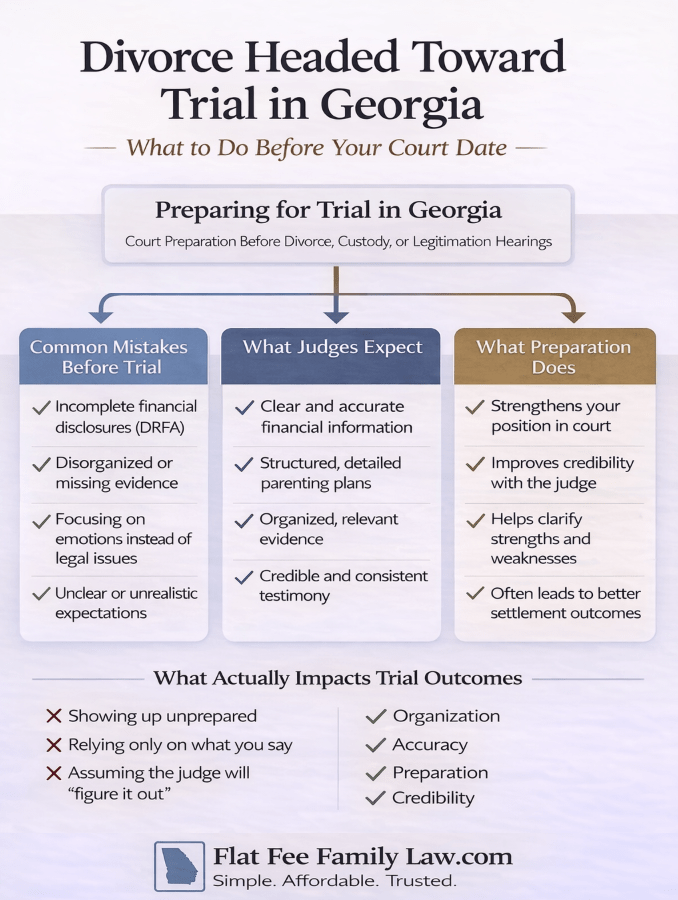
Divorce Headed Toward Trial in Georgia? Be Ready Before Your Court Date — Here’s Why
When a divorce, custody, or legitimation case in Georgia starts moving toward trial, everything changes. Up to that point, most cases are built around negotiation—offers, counteroffers, and attempts to reach an agreement. But once a court date is set and trial becomes likely, the focus shifts from resolution to preparation.
And here’s what many people misunderstand: trial outcomes are not decided in the courtroom alone—they are shaped in the weeks leading up to it.
If you’re heading toward a trial, what you do before your court date matters just as much—if not more—than what happens when you walk in.
Why Trial Preparation Matters More Than People Think
A trial is not a conversation. It’s not a negotiation. It’s not a chance to “tell your story.”
It is a structured legal process where a judge evaluates:
- Evidence
- Credibility
- Documentation
- Consistency
- Legal arguments
By the time your case is called, the judge expects:
- Clear positions from both sides
- Properly prepared financials
- Organized evidence
- Focused testimony
If you show up unprepared, you don’t just “wing it”—you lose control of your case.
What Judges Are Actually Looking For
In Georgia divorce and legitimation trials, judges are not trying to figure out who is “right” in a general sense.
They are looking for specific, legally relevant answers—and this is where many cases are won or lost, based on how clearly those answers are presented.
In Divorce Cases:
- How should assets and debts be divided?
- What is equitable (not necessarily equal)?
- What does the financial picture actually look like?
In Custody Cases:
- What is in the child’s best interest?
- Which parent has been the primary caregiver?
- What arrangement is stable and realistic?
In Legitimation Cases:
- Should the father be legally recognized?
- What custodial rights, if any, should be granted?
- What parenting plan structure is appropriate?
- Is the proposed involvement in the child’s best interest?
In Support Issues:
- What is each party’s true income?
- Are the financial disclosures accurate and complete?
This is why preparation matters so much. The party who presents clear, organized, credible information usually has the advantage.
The Biggest Mistake People Make Before Trial
Most people assume trial is about what they say. It’s not.
It’s about what you can prove. Common mistakes include:
- Showing up without key financial documents
- Not completing a proper Domestic Relations Financial Affidavit (DRFA)
- Bringing disorganized or irrelevant evidence
- Focusing on emotional arguments instead of legal ones
- Assuming the judge will “figure it out”
Judges don’t fill in gaps. If something isn’t presented clearly, it often doesn’t get considered the way you expect.
What “Being Ready” Actually Looks Like
Preparation for trial isn’t vague—it’s very specific.
1. Your Financials Are Complete and Accurate
Your Domestic Relations Financial Affidavit (DRFA) is one of the most important documents in your case. It must:
- Reflect your true income
- Include accurate monthly expenses
- Account for assets and debts
If your numbers are inconsistent or incomplete, it can damage your credibility immediately.
2. You Understand Your Case Strategy
You should be able to clearly answer:
- What are you asking the judge to decide?
- What outcome are you seeking?
- Why is that outcome supported by the facts?
If your position is unclear, your case will feel scattered—and that matters in court.
3. Your Evidence Is Organized
Evidence isn’t just “documents you bring.” It should be:
- Relevant
- Easy to follow
- Properly labeled
- Directly tied to your arguments
That includes:
- Financial records
- Communication (texts/emails)
- Parenting-related documentation
- Any supporting exhibits
Disorganized evidence weakens even a strong case.
4. You’re Prepared to Testify Clearly
Testimony matters—but only if it’s:
- Focused
- Consistent
- Relevant to the legal issues
Rambling, emotional, or unfocused testimony can hurt more than it helps. Judges are listening for:
- Facts
- Clarity
- Credibility
Trial Pressure Is Real — And It Affects Outcomes
Courtrooms are structured, formal, and often fast-moving. If you’re not prepared:
- You may forget key points
- You may struggle to respond clearly
- You may miss opportunities to present important information
On the other hand, preparation creates:
- Confidence
- Clarity
- Control
That difference shows—and judges notice it.
Why Some Cases Settle Right Before Trial
Here’s something most people don’t realize: a large number of cases settle right before trial.
Why? Because once both sides prepare seriously:
- The strengths and weaknesses of each case become clearer
- Expectations become more realistic
- Pressure increases
Being prepared doesn’t just help you at trial—it often puts you in a stronger position to reach a favorable settlement before trial happens.
Flat Fee Representation Becomes Especially Important at This Stage
As a case moves toward trial, costs can become unpredictable with traditional hourly billing. Preparation involves:
- Document review
- Strategy sessions
- Trial prep work
- Court appearances
With hourly billing, those costs can escalate quickly—especially close to trial. A flat fee structure provides:
- Cost certainty
- Clear scope of work
- Focus on preparation without billing pressure
That matters when the stakes are highest.
The Bottom Line
If your divorce, custody, or legitimation case is headed toward trial, the outcome won’t be decided by a single moment in court. It will be shaped by:
- How well you prepared
- How clearly you present your case
- How organized and credible your information is
The courtroom is where decisions are made—but preparation is where cases are won or lost.
Divorce Trial Coming Up? Don’t Walk In Unprepared.
What you do in the weeks before your court date can directly impact the outcome of your case. Whether you’re dealing with divorce, custody, or legitimation, having a clear plan—and being fully prepared—can make a real difference. If your case is moving toward trial, now is the time to make sure you’re fully prepared.
At Flat Fee Family Law, attorney Brendan Dalton works directly with clients to prepare for trial, focusing on strategy, organization, and what judges actually look for in court.
Schedule a consultation and get a clear plan before your court date.
Frequently Asked Questions
Do most divorce cases in Georgia go to trial?
No. Most cases settle before trial—but preparation is often what drives those settlements
What happens if I’m not fully prepared for trial?
You risk:
- Weak presentation of your case
- Missed evidence
- Reduced credibility
All of which can impact the outcome.
How important is the DRFA in a trial?
Extremely important. It forms the foundation of financial decisions in your case.
Can I still settle my case after a trial date is set?
Yes. Many cases resolve shortly before trial once both sides are fully prepared.
What should I do first if my case is headed toward trial?
Start organizing:
- Financial documents
- Case timeline
- Key issues you want decided
Then make sure your strategy is clear and focused.
What should I bring to a divorce trial in Georgia?
You should be prepared with:
- Completed and accurate financial documents (DRFA)
- Organized evidence and exhibits
- A clear understanding of your position and goals