
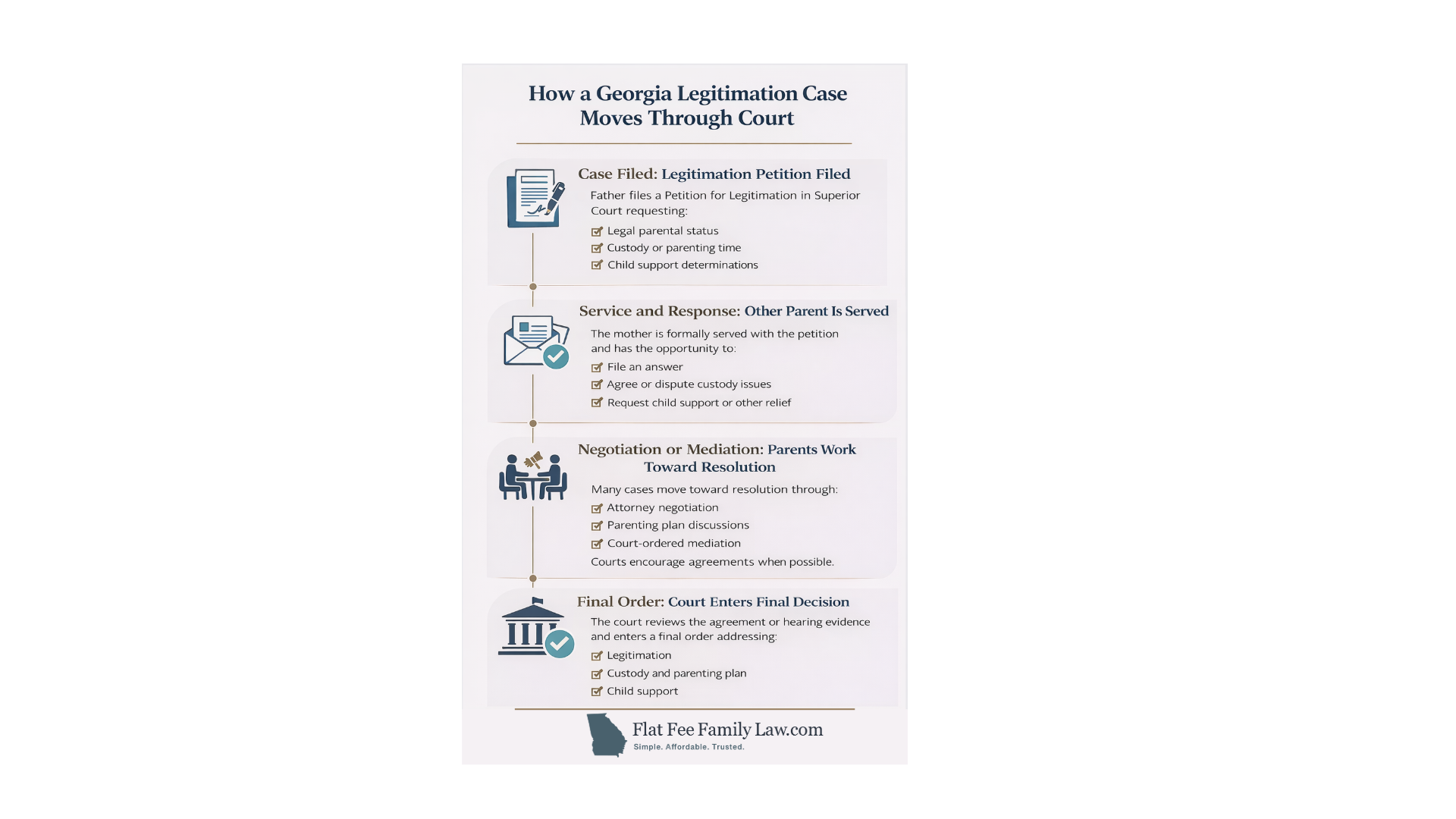
How a Georgia Legitimation Case Moves Through Court
When a father files for legitimation in Georgia, many parents want to understand how the court process works and what steps are involved. Legitimation cases follow a structured legal process in Georgia’s Superior Courts.
While each case involves unique circumstances, most follow the same general sequence of steps involving filing, service, responses, and ultimately a final court decision regarding parental rights, custody, and child support. Understanding how the process works can help parents prepare for each stage of the case and make informed decisions along the way.
Step-by-Step Process of a Georgia Legitimation Case
While every family situation is different, most legitimation cases move through several key stages in Georgia Superior Court.
1. Filing the Legitimation Petition
The process begins when the father files a Petition for Legitimation in the Superior Court of the county where the child’s mother lives. The petition typically asks the court to:
- Establish the father as the child’s legal parent
- Determine custody or parenting time
- Address child support obligations
Once the petition is filed, the court clerk issues a summons, which allows the other parent to be formally served with the legal documents.
2. Service of Process
After filing, the next step is service of process, meaning the mother must officially receive the court papers. Service is usually completed by:
- The county sheriff
- A private process server
The case generally cannot move forward until proper service has been completed. If the other parent cannot be located or service is unsuccessful, additional steps may be required before the court can proceed.
3. The Other Parent’s Response
After being served, the mother has the opportunity to file an answer with the court. In the response, she may:
- Agree with the legitimation request
- Dispute custody or parenting arrangements
- Request child support or other relief
If no response is filed, the case may proceed toward a default judgment. Even in default situations, the court will still review custody issues carefully to ensure the child’s best interests are protected.
4. Negotiation, Mediation, or Temporary Orders
Many legitimation cases involve discussions between the parents or their attorneys about important issues such as:
- Custody arrangements
- Parenting schedules
- Decision-making authority
- Child support
Georgia courts frequently encourage parents to resolve these issues through negotiation or mediation when possible. Mediation allows parents to work toward an agreement with the assistance of a neutral third party. In some situations, the court may enter temporary orders addressing parenting time or support while the case continues.
5. Final Hearing or Settlement
The final stage of a legitimation case typically involves either a negotiated agreement or a hearing before a judge. If the parents reach an agreement, the proposed order is submitted to the court for review and approval.
If the issues remain disputed, the court may schedule a final hearing where the judge considers evidence and arguments from both sides before issuing a decision. The final order entered by the court addresses legitimation as well as any related custody, parenting plan, and child support issues.
What Issues Courts Consider in Legitimation Cases
When deciding legitimation cases, Georgia courts focus on the best interests of the child. Depending on the circumstances, the court may evaluate factors such as:
- The relationship between the father and the child
- Each parent’s ability to provide a stable environment
- The child’s existing routine and living situation
- Each parent’s willingness to support the child’s relationship with the other parent
Because these cases affect parental rights and long-term custody arrangements, courts carefully review the facts before entering a final order.
Why Legitimation Matters
Legitimation establishes the legal relationship between a father and a child under Georgia law. Once legitimation is granted:
- The father becomes the child’s legal parent
- The father may seek custody or parenting time
- The father gains the ability to participate in major decisions affecting the child
Without legitimation, Georgia law generally places sole legal custody with the mother when parents are unmarried.
Final Thoughts
Legitimation cases follow a structured legal process designed to determine parental rights, custody arrangements, and child support obligations. Understanding the steps involved can help parents approach the process with clearer expectations and better preparation.
Questions About Legitimation in Georgia?
Legitimation cases often involve important decisions about custody, parenting time, and child support.
Our attorney at Flat Fee Family Law.com has handled hundreds of family law cases across Georgia, including legitimation matters involving custody, parenting plans, and support. If you would like to discuss your situation, you can schedule a consultation.
Frequently Asked Questions
How does the legitimation process work in Georgia?
The process generally begins when a father files a petition for legitimation in Superior Court. The other parent must then be formally served and given the opportunity to respond. The court may require negotiation or mediation before issuing a final order addressing legitimation, custody, parenting time, and child support.
Can a legitimation case be resolved without a contested hearing?
Yes. Many legitimation cases are resolved through agreement between the parents. When an agreement is reached, the proposed order may be submitted to the judge for approval without a contested hearing.
Does legitimation automatically give the father custody?
No. Legitimation establishes the father as the child’s legal parent, but custody decisions are made separately by the court based on the best interests of the child.
Can legitimation be denied in Georgia?
Although it is not common, courts may deny legitimation if granting it would not be in the child’s best interests. Courts evaluate the specific facts of each case before making a decision.
Does legitimation affect child support?
Yes. Once legitimation is granted, the court may establish child support obligations based on the Georgia Child Support Guidelines.
Can a father see his child before legitimation is finalized?
In some cases, the court may enter temporary parenting time orders while the case is pending. Parents may also agree on visitation arrangements during the case.