The Documents That Can Win—or Hurt—Your Case at a Georgia Final Hearing
When your case reaches a final hearing in a Georgia family law matter, the focus shifts from allegations to proof. What you can show—clearly, cleanly, and credibly—often matters more than what you say.
Judges are not just listening. They are reviewing documents, comparing versions of events, and looking for consistency. The paperwork you bring into the courtroom can strengthen your position—or quietly undermine it.
This is where many cases are won or lost.
Why Documents Matter More Than You Think
By the time a case reaches a final hearing, both sides have usually told their story. Pleadings have been filed. Positions are clear. What the court is looking for at this stage is support. That support comes from:
- Financial records
- Communication history
- Parenting involvement
- Evidence of behavior over time
Judges rely on documents because they provide something testimony alone cannot: a fixed, reviewable record.
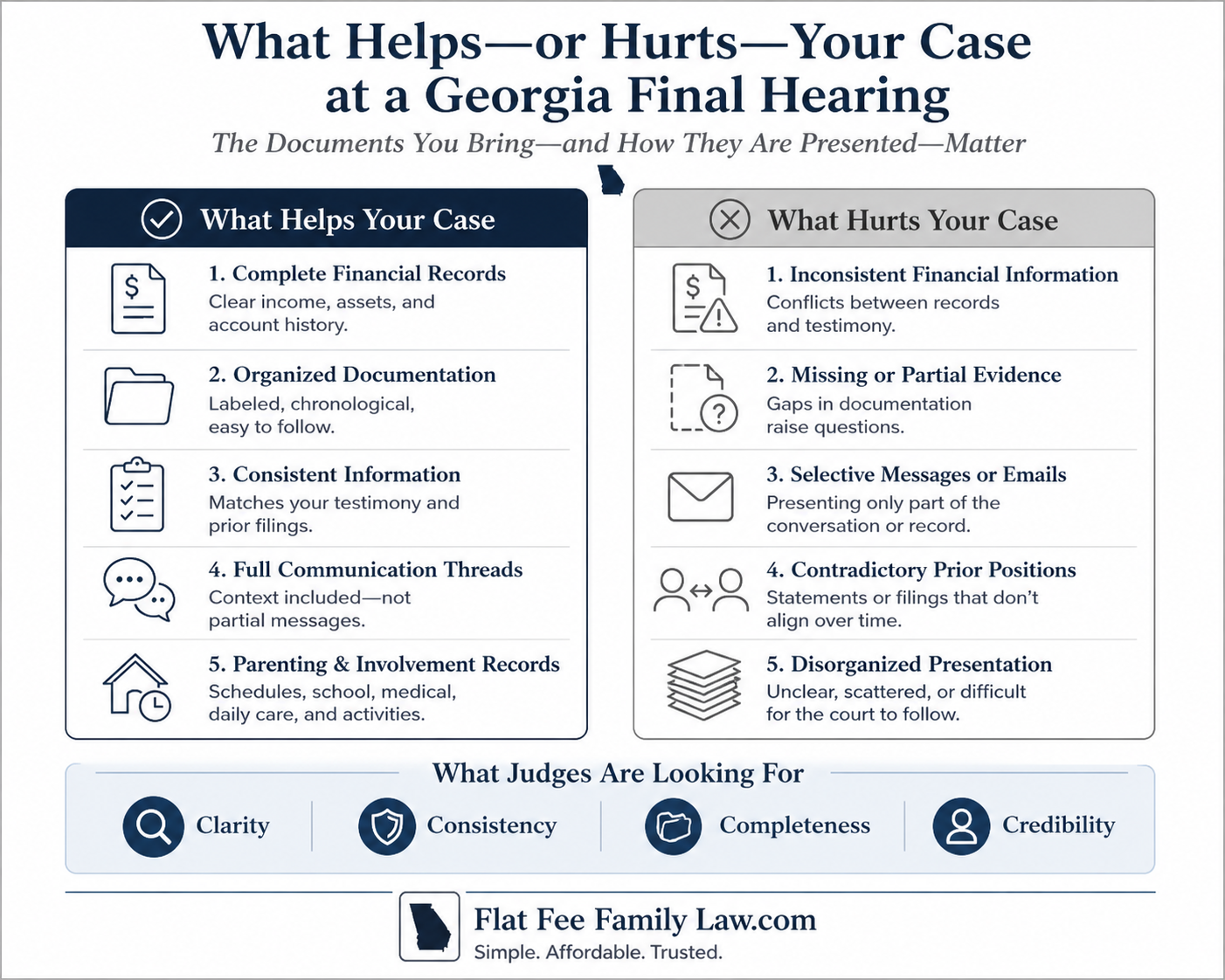
If your documents are organized, consistent, and aligned with your testimony, they reinforce your credibility. If they are incomplete, contradictory, or missing, they raise questions—even if your position is otherwise strong.
The Most Important Documents in a Georgia Final Hearing
While every case is different, most final hearings in Georgia family law cases revolve around a core set of documents.
Financial Records
In divorce and child support cases, financial documentation is critical.
This typically includes:
- Pay stubs and income statements
- Tax returns (usually the last 2–3 years)
- Bank account statements
- Credit card statements
- Retirement account summaries
- Business records (if applicable)
These documents directly impact:
- Child support calculations
- Division of assets and debts
- Claims about financial misconduct or hidden income
If your financial picture is unclear or inconsistent, it becomes difficult for the court to rule in your favor on these issues.
Parenting and Custody Evidence
In custody cases, the court is evaluating the best interests of the child. Documents that show actual parenting involvement carry significant weight.
Examples include:
- School records and attendance logs
- Medical records
- Extracurricular activity schedules
- Emails or messages with teachers, coaches, or providers
- Calendars showing parenting time
These records help demonstrate:
- Who is actively involved in day-to-day parenting
- Stability and consistency
- Ability to meet the child’s needs
This is a strong place to internally link to your custody factors or parenting plan content.
Communication Between the Parties
Text messages, emails, and other communications often become key exhibits.
They can be used to show:
- Cooperation—or lack of it
- Attempts to resolve issues
- Harassment or inappropriate behavior
- Agreement or disagreement on key issues
But this category cuts both ways. The same messages you believe help your case can be interpreted differently when reviewed in full context. Selective presentation or missing threads can raise concerns about credibility.
Court Filings and Prior Orders
Everything that has been filed in your case matters. This includes:
- The original complaint or petition
- Answers and counterclaims
- Motions filed during the case
- Temporary orders
Judges often compare what is being argued at the final hearing with what has been stated earlier in the case. If your position has shifted without explanation, it can weaken your overall argument.
Documents That Commonly Hurt a Case
If your case is heading toward a final hearing, this is often the stage where preparation makes the biggest difference. Understanding how your documents will be reviewed—and making sure they are properly organized—can directly impact how your case is presented in court. Not all documents help—even when a party believes they will. Some of the most damaging issues arise from:
Inconsistent Financial Records
If your bank statements, tax returns, and testimony do not align, the court may question accuracy—or intent. Even small discrepancies can create larger credibility concerns.
Incomplete or Selective Evidence
Providing only part of a communication thread or partial financial records can backfire. Courts expect full context. Missing pieces often raise more questions than they answer.
Informal Agreements That Conflict with Court Positions
Messages where parties previously agreed to certain arrangements (custody schedules, financial support, etc.) can be used to challenge current claims. Even if those agreements were informal, they can still influence how the court views credibility and reasonableness.
Disorganized Presentation
Even strong documents lose impact if they are difficult to follow. Stacks of unorganized paperwork, missing labels, or unclear timelines can make it harder for the court to understand your position. Clarity matters.
How Judges Evaluate Documents at a Final Hearing
Judges are not just looking at individual documents—they are looking at how everything fits together. They are asking:
- Do the documents match the testimony?
- Is there consistency over time?
- Are there gaps or contradictions?
- Does the evidence support a clear, logical narrative?
A well-prepared case tells a consistent story across all documents. A poorly prepared case feels fragmented—even if some individual pieces are strong. This is often where cases break down—not because of the underlying facts, but because those facts are not clearly supported or presented.
Preparation Matters More Than Volume
Bringing more documents is not always better. What matters is:
- Relevance
- Organization
- Clarity
- Consistency
A focused set of well-prepared documents is often more effective than an overwhelming volume of loosely related materials. This is where many people underestimate the importance of preparation before a final hearing.
How This Fits Into the Bigger Picture
Final hearings are not just about presenting documents—they are about presenting a case. Documents are one part of that process, along with:
- Testimony
- Legal arguments
- Application of Georgia law
If you want a broader understanding of how final hearings work in Georgia, including what to expect in court and how decisions are made, it helps to understand how these documents fit into the broader process of a contested family law case in Georgia.
Be Prepared Before You Walk Into Court
Final hearings are about more than showing up. They’re about presenting a clear, supported case—backed by the right documents and a consistent strategy.
If your divorce or legitimation case is heading toward a final hearing, preparation matters.
At Flat Fee Family Law, Brendan Dalton represents clients across Georgia in contested family law cases with clear, flat-fee pricing—so you know exactly what to expect as your case moves forward.
If you’re ready to talk through your situation, schedule a call here: