What Happens If a Judge Rejects a Settlement Agreement in a Georgia Divorce or Legitimation Case
Why This Matters More Than Most People Realize
Most family law cases in Georgia settle before trial. In fact, by the time you reach a final hearing, many people assume the agreement they’ve worked out will simply be approved.
That’s usually true—but not always.
Judges are not required to accept your agreement. If something doesn’t meet legal standards or raises concerns, the judge can reject it.
And when that happens, it can catch people completely off guard.
Are Judges Allowed to Reject a Settlement Agreement?
Yes.
In both divorce and legitimation cases, a judge must review and approve the final agreement before it becomes a court order.
This applies to:
- Settlement agreements in divorce cases
- Parenting plans
- Child support calculations
- Legitimation agreements involving custody and visitation
Even if both parties agree, the judge still has an independent obligation to make sure the agreement is legally proper—especially when children are involved.
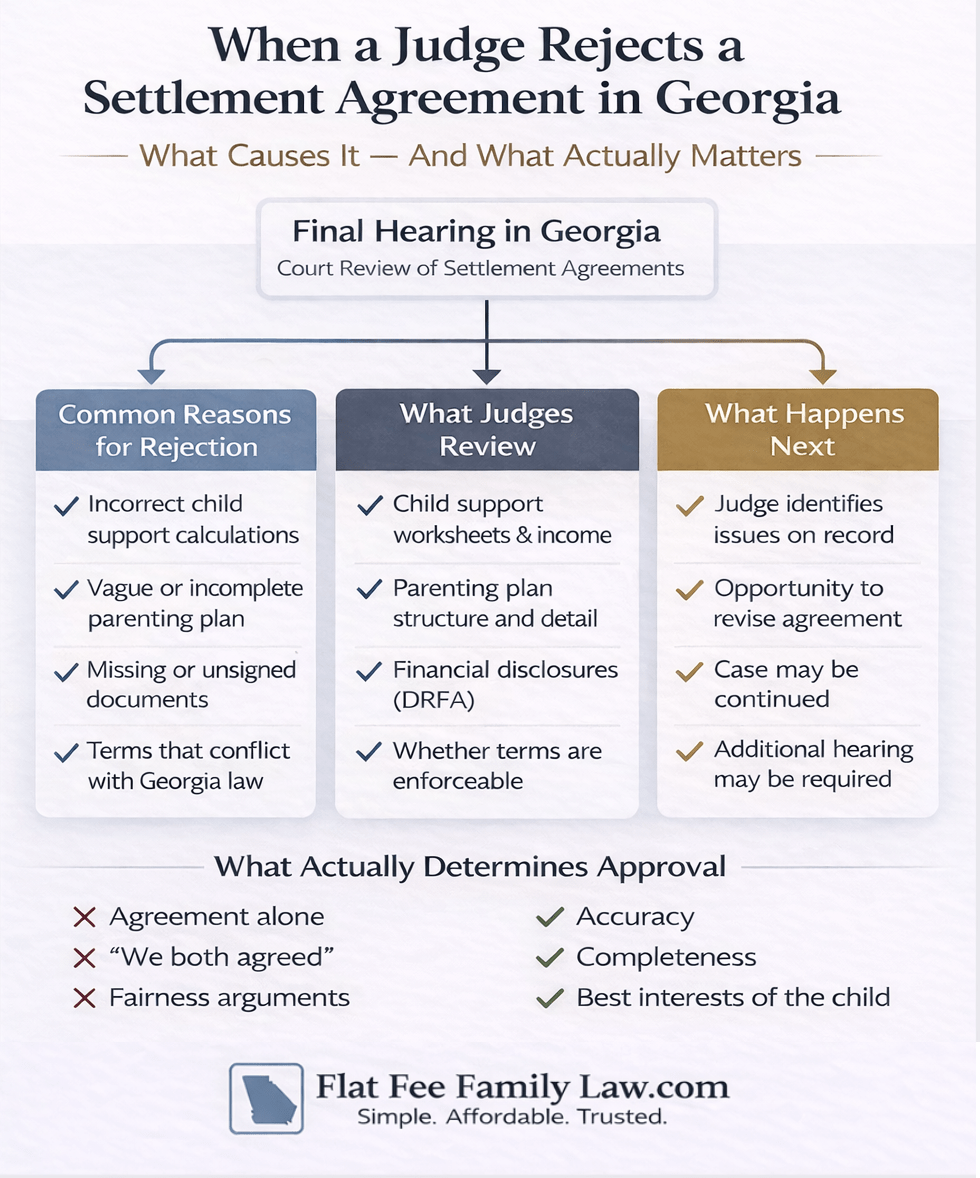
The Most Common Reasons Judges Reject Agreements
1. The Child Support Is Incorrect
This is one of the biggest issues.
Georgia has specific child support guidelines, and judges expect:
- Accurate financial reporting
- Proper calculations
- Required worksheets
If the numbers don’t match the guidelines—or aren’t explained properly—the judge may reject the agreement.
2. The Parenting Plan Is Vague or Incomplete
A parenting plan must be specific and workable. Judges often reject plans that:
- Don’t clearly define parenting time
- Are too vague about holidays or exchanges
- Don’t address decision-making authority
If a judge can’t enforce it, they won’t approve it.
3. The Agreement Doesn’t Appear Fair or Reasonable
Even in uncontested cases, judges may step in if something looks off. Examples:
- One party gives up everything with no clear explanation
- Financial terms seem extremely one-sided
- A party may not fully understand what they’re agreeing to
This comes up more often than people expect.
4. Required Documents Are Missing or Incomplete
Final hearings require more than just an agreement. Issues that trigger rejection:
- Missing Domestic Relations Financial Affidavit (DRFA)
- Incomplete filings
- Incorrect or unsigned documents
This is especially common in DIY or rushed cases.
5. The Agreement Conflicts With Georgia Law
Some terms simply won’t be approved, even if both parties agree. Examples:
- Waiving child support improperly
- Agreements that restrict a child’s best interests
- Terms that aren’t legally enforceable
What Happens Immediately If the Judge Rejects It?
This is where people get nervous—but it’s usually not the end of the case. In most situations, the judge will identify the issue and determine what needs to happen next.
Option 1: Judge Identifies the Issue and Allows Corrections
This is the most common outcome. The judge may:
- Point out what needs to be fixed
- Allow you to revise the agreement
- Continue the hearing to a later date
Option 2: Judge Requires Additional Information
Sometimes the judge needs more clarity. They may ask for:
- Updated financial information
- Revised child support calculations
- A more detailed parenting plan
Option 3: Case Moves Forward for Further Proceedings
If the issues are significant—or can’t be resolved quickly—the case may move forward instead of being finalized through settlement. This could mean:
- Additional hearings
- Mediation
- Or, in some cases, trial
How This Impacts Timing
One of the biggest misconceptions is that settlement guarantees a quick resolution. If an agreement is rejected:
- Your final order is delayed
- You may need to revise documents
- A new hearing date may be required
In some courts, that delay can be significant depending on the court’s calendar.
How to Avoid Having Your Agreement Rejected
This is where preparation makes a real difference.
1. Get the Child Support Right
- Use accurate income numbers
- Complete the required worksheets
- Be prepared to explain any deviations
2. Make the Parenting Plan Specific
- Clearly define schedules
- Address holidays, transportation, and decision-making
- Avoid vague language
3. Complete All Required Documents
- DRFA (fully completed and notarized)
- Properly executed agreement
- All required filings submitted in advance
4. Make Sure the Agreement Is Workable
Judges are looking for agreements that:
- Can actually be followed
- Are enforceable
- Reflect a realistic arrangement
5. Prepare for the Final Hearing
Even in uncontested cases, preparation matters. Judges may ask questions to confirm:
- Both parties understand the agreement
- The terms are voluntary
- The arrangement is appropriate
What Judges Are Really Looking For
At the end of the day, judges are focused on a few key things:
- Is this legally correct?
- Is this complete and enforceable?
- If children are involved, is this in their best interests?
If the answer to any of those is “no” or “unclear,” the agreement may not be approved.
Final Thoughts
Having a settlement agreement is a major step—but it’s not the final step. Court approval is required, and that process involves real review—not just a signature. The good news is that most issues can be fixed if they’re caught. The key is being prepared before you walk into court, not trying to fix things after the fact.
Need Help Preparing for a Final Hearing in Georgia?
At Flat Fee Family Law, we help clients prepare agreements, correct issues before court, and step in when cases need to be finalized properly. You can learn more about working with our attorney, Brendan Dalton, or schedule a consultation if your case is approaching a final hearing or you want to make sure everything is ready before court.
Frequently Asked Questions
Can a judge reject a settlement agreement in a Georgia divorce case?
Yes. In Georgia, a judge must review and approve all settlement agreements before they become final orders. Even if both parties agree, the judge can reject the agreement if it does not meet legal requirements or raises concerns.
Do both parties have to go back to court if the agreement is rejected?
Yes. If a judge does not approve the agreement, the case remains open. The parties will typically need to return to court after making corrections or providing additional information.
Why would a judge reject a settlement agreement in Georgia?
Common reasons include incorrect child support calculations, incomplete or vague parenting plans, missing required documents, or terms that are not legally enforceable. Judges may also reject agreements that appear unfair or not in a child’s best interests.
Can you fix a settlement agreement after it is rejected?
Yes. Most issues can be corrected, such as updating child support calculations, revising a parenting plan, or submitting missing documents. Once corrected, the agreement can be resubmitted for approval.
Will a rejected agreement delay my divorce or legitimation case?
Yes. If an agreement is rejected, the final order will be delayed while corrections are made and a new hearing is scheduled. The length of the delay depends on the court’s calendar and how quickly the issues are resolved.
Can a judge reject a parenting plan in Georgia?
Yes. Judges frequently reject parenting plans that are too vague, incomplete, or not practical. Parenting plans must clearly define schedules, decision-making authority, and other key terms.
What if both parties agree to waive child support?
A judge may still reject the agreement. Child support is governed by Georgia guidelines, and deviations must be properly documented and justified. Judges will not approve agreements that improperly waive support.
Do I need a Domestic Relations Financial Affidavit (DRFA) for a final hearing?
In most cases, yes. A completed and notarized DRFA is required, especially when child support or financial issues are involved. Missing or incomplete financial affidavits are a common reason agreements are rejected.
Can a judge change the terms of our agreement?
Generally, judges will not rewrite your agreement. Instead, they will reject it and require corrections. It is up to the parties to revise and resubmit an acceptable agreement.
How can I avoid having my agreement rejected?
The best way to avoid rejection is to ensure that all documents are complete, child support is calculated correctly, and the parenting plan is clear and detailed. Preparation before the final hearing is critical.
What should I do if my court date is coming up and I’m not sure my agreement is correct?
You should have your agreement reviewed before your hearing. Fixing issues in advance is significantly easier than dealing with a rejected agreement and a delayed case.