
What Happens After You Use the Georgia Child Support Calculator?
When parents use the Georgia child support calculator, they are often looking for a quick answer to a stressful question: “What will child support actually look like in my case?” The calculator can provide a useful starting point, but many people are surprised to learn that the number generated by the calculator is not always the final amount ordered by the court.
In Georgia divorce, legitimation, and custody cases, child support calculations are often only one part of a much larger legal and financial process. Parenting schedules, income disputes, healthcare costs, childcare expenses, and custody arrangements can all affect the final outcome.
Understanding what usually happens after using the Georgia child support calculator can help parents better prepare for the next stages of a family law case and avoid common misunderstandings early in the process.
What the Georgia Child Support Calculator Actually Does
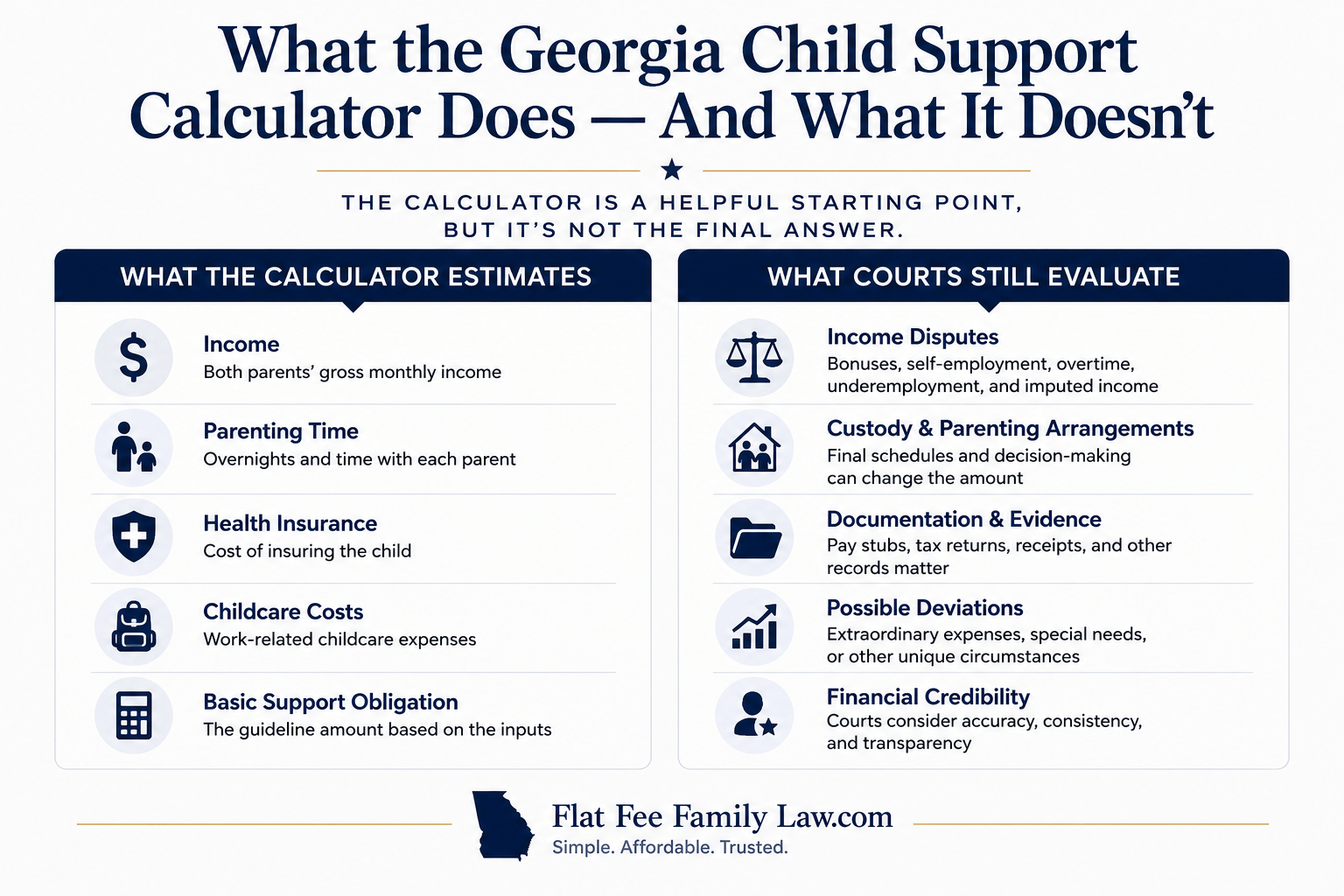
Georgia uses an “income shares” model for child support. The purpose of the calculator is to estimate how much financial support should be contributed toward the child based on both parents’ income and certain child-related expenses.
The calculator generally considers factors such as:
- Gross monthly income for both parents
- Parenting time arrangements
- Health insurance costs for the child
- Work-related childcare expenses
- Existing child support obligations
- Number of children involved
The calculator then generates an estimated support amount using Georgia’s statutory child support guidelines. For many parents, this is the first time they begin seeing how custody schedules and financial information directly affect support calculations.
If you are still learning how Georgia child support works generally, our Georgia Child Support Basics resource may also be helpful.
Why the Calculator Result Is Not Always the Final Number
One of the biggest misconceptions is that the calculator automatically determines exactly what a judge will order. In reality, the calculator is only as accurate as the information entered into it, and many cases involve disputes about the underlying numbers themselves. The following is additional information about common issues that can affect child support calculations; because of these, the initial calculator result is often only the beginning of the conversation.
Disputes About Income
Parents may disagree about:
- Actual earnings
- Bonuses or commissions
- Self-employment income
- Overtime
- Cash income
- Underemployment or unemployment
In some cases, courts may “impute” income if a parent is believed to be voluntarily unemployed or intentionally earning less than they reasonably could.
Parenting Time Disagreements
Child support calculations are often affected by parenting schedules. When parents disagree about custody arrangements, the support calculation may change substantially depending on the final parenting plan. This is one reason custody disputes and child support disputes frequently overlap.
Healthcare and Childcare Costs
Parents sometimes overlook how much the following can affect the final worksheet calculations:
- Health insurance premiums
- Daycare costs
- After-school care
- Extracurricular expenses
Deviations from Guideline Support
Georgia courts can sometimes deviate from standard guideline support amounts under certain circumstances. While deviations are not automatic, they can become an issue in cases involving:
- Extraordinary educational expenses
- Special medical needs
- High-income households
- Significant parenting time adjustments
- Other unusual financial circumstances
What Usually Happens Next in a Family Law Case
After using the child support calculator, the next steps often depend on whether the case is uncontested or contested.
In Uncontested Cases
When parents generally agree on custody, parenting schedules, and financial issues, the process is often more straightforward. The parties may move forward with:
- Drafting a settlement agreement
- Preparing a parenting plan
- Completing formal child support worksheets
- Exchanging financial information
- Filing uncontested paperwork with the court
In many uncontested cases, the calculator helps parents begin negotiating realistic expectations before documents are finalized.
In Contested Cases
When parents disagree about custody, income, parenting time, or financial information, the process often becomes significantly more involved. The case may include:
- Discovery requests
- Financial disclosures
- Requests for documents
- Temporary hearings
- Mediation
- Negotiations between attorneys
- Updated child support worksheets
- Final hearings or trial
As additional financial information becomes available, support calculations may change multiple times throughout the case.
Documents Parents Often Need After Running the Calculator
Once child support becomes part of a legal case, accurate documentation becomes extremely important. Common documents may include:
- Pay stubs
- Tax returns
- W-2s or 1099s
- Health insurance documentation
- Childcare invoices
- Bank statements
- Existing support orders
- Parenting schedules
- Employment records
Parents who maintain organized financial records are often in a much stronger position during negotiations and litigation.
Common Mistakes People Make After Using the Calculator
Many parents unknowingly create problems by misunderstanding what the calculator is designed to do. Common mistakes include:
- Assuming the Calculator Is Automatically Accurate – the result depends entirely on the accuracy of the information entered. Even small income differences can substantially affect support calculations.
- Guessing Parenting Time – projected schedules that do not reflect reality can create unrealistic expectations regarding support obligations.
- Ignoring Variable Income – bonuses, commissions, self-employment income, and inconsistent earnings often require closer analysis than a basic calculator estimate.
- Assuming Equal Custody Means No Child Support – many parents are surprised to learn that child support may still be owed even when parenting time is shared relatively evenly.
- Failing to Update Financial Information – support calculations often evolve as more accurate financial records become available during the case.
How Georgia Courts Actually Use Child Support Calculations
Georgia courts generally require formal child support worksheets as part of custody, divorce, and legitimation cases involving children. Judges are typically evaluating:
- Whether the financial information appears accurate
- Whether the parenting schedule is realistic
- Whether guideline support is appropriate
- Whether deviations are justified
- Whether the proposed arrangement serves the child’s best interests
The court is not simply reviewing one calculator result in isolation. Child support is usually evaluated alongside broader custody and parenting issues.
Child Support Issues in Divorce vs. Legitimation Cases
Child support issues can arise in both divorce and legitimation cases, but the surrounding legal issues are often different. In divorce cases, child support is typically addressed alongside:
- Property division
- Alimony
- Parenting plans
- Custody arrangements
In legitimation cases, child support disputes often overlap with:
- Establishing parental rights
- Custody disputes
- Parenting time requests
- Decision-making authority
Because of this, support calculations are frequently tied closely to the overall custody structure being proposed in the case.
How Georgia Counties May Handle Child Support Cases Differently
Although Georgia child support law is statewide, court procedures and timelines can vary by county. Metro Atlanta counties such as Fulton, Cobb, and Gwinnett often handle large volumes of family law litigation, which can affect:
- Scheduling
- Temporary hearing timelines
- Mediation requirements
- Case pacing
Some counties move cases faster than others, while heavily populated jurisdictions may experience longer delays due to crowded court calendars.
Final Thoughts
The Georgia child support calculator can be a very helpful starting point, but it is not always the final answer in a custody, divorce, or legitimation case. Parenting schedules, financial documentation, custody disputes, and court procedures can all significantly affect the final support determination.
Parents who understand the process early, maintain organized financial information, and approach child support issues realistically are often better prepared for negotiations, mediation, and court proceedings later in the case.
At Flat Fee Family Law, Brendan Dalton works with clients throughout Georgia in divorce, legitimation, custody, and child support matters involving parenting plans, financial disclosures, temporary hearings, and contested family law litigation.
If you have questions about child support calculations in Georgia or want to better understand how child support may be evaluated in your case, schedule a call to discuss your situation and learn more about your options.
FAQs
Is the Georgia Child Support Calculator accurate?
The calculator can provide a helpful estimate, but the accuracy depends entirely on the information entered. Income disputes, parenting schedules, healthcare costs, childcare expenses, and other financial issues can all affect the final support amount ordered by the court.
Does the Georgia Child Support Calculator determine the final child support order?
No. The calculator is only a starting point. Georgia courts typically review formal child support worksheets, financial documentation, custody arrangements, and other evidence before entering a final child support order.
What information do I need to use the Georgia Child Support Calculator?
Most calculators require information such as, more accurate financial information generally leads to more reliable estimates:
- Gross monthly income for both parents
- Health insurance costs for the child
- Childcare expenses
- Existing child support obligations
- Parenting time arrangements
Can child support change if custody changes?
Yes. Parenting time and custody arrangements often directly affect child support calculations. Changes to the parenting schedule can sometimes increase or decrease support obligations.
Does equal custody mean neither parent pays child support?
Not necessarily. Many parents are surprised to learn that child support may still be owed even when parenting time is shared relatively evenly. Income differences and other financial factors can still affect the calculation.
What documents are commonly needed for child support calculations in Georgia?
Common documents may include, accurate financial documentation is often important in both negotiations and contested cases:
- Pay stubs
- Tax returns
- W-2s or 1099s
- Health insurance records
- Childcare invoices
- Existing support orders
- Parenting schedules
Can child support calculations change during a divorce or legitimation case?
Yes. Child support worksheets are often updated as additional financial information becomes available or as custody and parenting schedules change during the case.
What happens after using the Georgia Child Support Calculator?
In uncontested cases, parents may move forward with settlement agreements and formal child support worksheets. In contested cases, disputes over income, custody, parenting time, or financial documentation may lead to mediation, temporary hearings, discovery, or litigation.
Do Georgia judges always follow the child support guidelines?
Georgia courts generally begin with the statutory child support guidelines, but judges may sometimes approve deviations under certain circumstances depending on the facts of the case.
How does child support work in Georgia legitimation cases?
In legitimation cases, child support is often addressed alongside custody, parenting time, and parental rights issues. The support calculation may be closely tied to the parenting arrangement ultimately approved by the court.