
Can You Change Your Mind After Signing a Divorce Settlement Agreement in Georgia?
Signing a divorce settlement agreement is an important step toward resolving an uncontested divorce in Georgia. But what happens if you sign the agreement and later realize you disagree with part of it? Can you change your mind before the divorce is finalized?
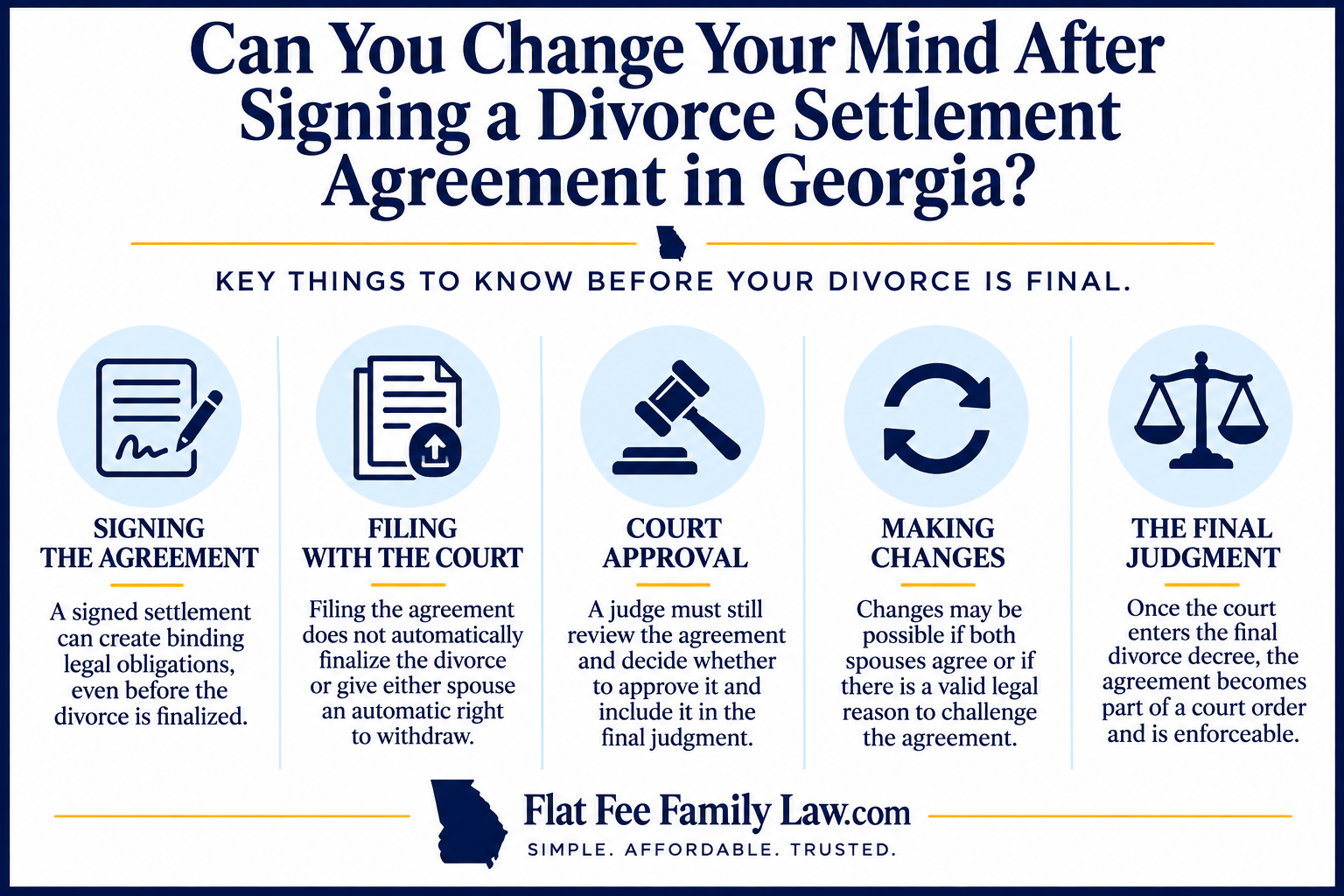
The answer depends on the circumstances, but signing an agreement can create binding legal obligations even before a judge enters the final divorce decree. Simply changing your mind does not automatically cancel the agreement. Understanding the difference between signing a settlement agreement, filing it with the court, obtaining judicial approval, and receiving a final divorce judgment can help you determine what options may still be available.
Is a Divorce Settlement Agreement Legally Binding Once You Sign It in Georgia?
A divorce settlement agreement is a written agreement between spouses addressing the terms of their divorce. Depending on the circumstances, it may cover:
- Division of marital property and debts.
- Ownership or sale of the marital home.
- Retirement accounts and other financial assets.
- Alimony or spousal support.
- Child custody and parenting time.
- Child support and related expenses.
In Georgia, a properly executed divorce settlement agreement may be enforceable as a contract even before it becomes part of a final divorce judgment. This distinction matters because signing the agreement and finalizing the divorce are not the same event.
A judge must still review the proposed settlement before incorporating it into a final divorce decree. However, the fact that the divorce has not yet been finalized does not necessarily allow either spouse to withdraw from the agreement without legal consequences.
Can You Change a Divorce Settlement Agreement Before It Is Filed?
If both spouses agree that a provision should be changed, they may be able to revise the settlement agreement before submitting it to the court. For example, spouses might decide to:
- Change how a bank account will be divided.
- Adjust the timeline for selling their home.
- Revise responsibility for a particular marital debt.
- Modify a proposed parenting schedule.
- Clarify language that could cause confusion later.
Any changes should be properly documented and signed as appropriate. Informal conversations or verbal promises may create disagreements about which terms actually apply. If only one spouse wants to change the agreement, the situation becomes more complicated.
The other spouse may insist that the original signed agreement remains enforceable. Depending on the circumstances, the dispute may require legal review or court involvement. A spouse should not assume that an agreement becomes optional simply because it has not yet been filed.
What Happens if You Change Your Mind After the Agreement Is Filed?
Filing a signed divorce settlement agreement with the court does not automatically finalize the divorce. The court must still determine whether the agreement should be approved and incorporated into the final judgment. However, filing does not necessarily give either spouse a new opportunity to withdraw from otherwise enforceable terms. If one spouse no longer agrees, several outcomes may be possible:
- Both spouses agree to revisions. They may submit an appropriately revised agreement for the court’s consideration.
- One spouse challenges enforceability. The court may need to determine whether the original agreement is legally enforceable.
- One spouse wants different terms but has no legal basis to invalidate the agreement. The other spouse may seek enforcement of the signed settlement.
- The court identifies a legal problem with the proposed agreement. The court may decline to approve some or all of its terms.
The specific circumstances matter. A disagreement after signing does not automatically make an agreement unenforceable.
Can a Georgia Judge Approve a Divorce Agreement if One Spouse Changes Their Mind?
Potentially, yes.
Georgia courts have recognized that a settlement agreement may be binding between spouses even though the judge retains authority to review it before incorporating it into a final divorce decree. For example, a spouse might sign a settlement agreement voluntarily and later decide that the property division is less favorable than expected.
That change of opinion, standing alone, generally does not establish that the agreement is invalid. A court may consider whether the agreement was properly formed, whether it is enforceable, and whether its provisions comply with applicable law.
The court’s independent review is particularly important when the agreement addresses matters involving children. The important distinction is that the judge’s authority to approve or reject a settlement does not give either spouse an automatic right to cancel it.
When Can a Divorce Settlement Agreement Be Challenged in Georgia?
There are circumstances in which a spouse may have grounds to challenge an agreement. Potential issues include:
Fraud or Misrepresentation
A spouse may question the validity of an agreement if the other spouse intentionally misrepresented or concealed important information that affected the settlement. For example, undisclosed financial assets or materially inaccurate representations about marital property may raise questions about whether the agreement was properly obtained. Not every omission or disagreement establishes fraud. The particular facts and available evidence matter.
Duress or Improper Pressure
A settlement agreement may be challenged when a spouse alleges that improper coercion or duress affected the decision to sign. However, feeling stressed about divorce or regretting a difficult compromise is not necessarily the same as legally recognized duress.
Mistake or Problems With the Agreement
An agreement may also raise enforceability questions when there is a legally significant mistake, uncertainty about essential terms, or another recognized contract-law issue. For example, spouses may disagree about whether the written document accurately reflects the terms they actually accepted. Whether these circumstances justify relief depends on the applicable law and supporting evidence.
Terms That Do Not Comply With Georgia Law
A judge is not required to approve an agreement merely because both spouses signed it. Certain provisions may require additional review, particularly those involving child custody or child support. The court must apply the relevant legal standards rather than automatically accepting every proposed term.
What if You Change Your Mind About Child Custody or Parenting Time?
Child custody and parenting arrangements require special consideration because Georgia courts evaluate custody matters under the child’s best interests. A proposed parenting plan may address:
- Where the child will primarily live.
- How parenting time will be divided.
- Holiday and vacation schedules.
- Transportation and exchanges.
- Decision-making responsibilities.
If both parents agree that the proposed arrangements should change before the divorce is finalized, they may be able to submit revised terms for court consideration.
If they disagree, the court may need to resolve the disputed issues. After a final custody order is entered, changes generally must follow Georgia’s applicable custody-modification procedures. A parent’s change of preference alone does not necessarily justify modifying an existing order.
Can You Change a Divorce Settlement Agreement After the Final Divorce Decree?
Once a judge enters the final divorce judgment, the legal situation changes significantly. When a settlement agreement is incorporated into the final decree, its provisions become part of the court’s judgment. Different types of provisions are treated differently under Georgia law.
- Property division: Final property-division provisions generally cannot be reopened simply because one spouse later regrets the arrangement. Limited legal remedies may be available in circumstances involving recognized grounds for challenging a judgment.
- Child custody: Custody arrangements may be modified when the applicable legal requirements are satisfied, including consideration of the child’s best interests.
- Child support: Child support may be modified under Georgia law when the statutory requirements for modification are met.
It is important not to assume that all divorce settlement provisions can be changed through the same process.
What Should You Do if You Regret Signing a Divorce Settlement Agreement?
If you have signed an agreement and now have concerns, the most useful first step is to determine exactly where your divorce stands. Consider the following questions:
- Have both spouses signed the agreement?
- Has the agreement been filed with the court?
- Has the judge already entered a final divorce decree?
- Which specific provisions do you want to change?
- Does the other spouse agree to the proposed changes?
- Are your concerns based on new information, a possible legal problem, or simply a different preference?
These details can help an attorney assess whether the agreement may be revised, whether enforceability is disputed, or whether the final judgment limits the available options. If the court has not yet entered a final judgment, it is particularly important to address concerns promptly rather than assume they can be resolved afterward.
Why Reviewing Your Divorce Agreement Before Signing Matters
An uncontested divorce generally means the spouses have reached agreement on the issues necessary to resolve their case. That agreement can help avoid prolonged litigation, but it also makes careful review essential. Property division, debt responsibility, parenting arrangements, and financial obligations can have lasting consequences. A settlement agreement should accurately reflect what both spouses understand and intend before it is signed.
At Flat Fee Family Law, attorney Brendan Dalton provides uncontested divorce representation throughout Georgia for a predictable $2,000 flat fee, including standard filing fees. Our firm helps clients prepare and finalize uncontested divorce paperwork, including settlement agreements, with direct attorney guidance and transparent pricing.
If you are considering an uncontested divorce in Georgia, understanding your agreement before signing can help you move forward with greater confidence. Schedule a consultation to discuss your circumstances and the next steps in your divorce.
Frequently Asked Questions About Changing a Divorce Settlement Agreement in Georgia
Can I cancel a divorce settlement agreement after signing it?
Not automatically. A signed agreement may be legally enforceable even before the divorce is finalized. Whether it can be challenged or revised depends on the circumstances and applicable law.
Can my spouse force me to follow a divorce agreement I no longer want?
Potentially. If the agreement is enforceable, your spouse may ask the court to enforce it. The court must evaluate the agreement and any legally supported objections.
Can we change our divorce agreement if we both agree?
Often, yes, particularly before the final judgment. The changes should be properly documented and submitted for court approval when required. After a final decree, additional legal restrictions may apply.
Does filing a divorce agreement mean we are officially divorced?
No. Filing an agreement does not itself dissolve the marriage. A final judgment and decree of divorce must be entered by the court.
Can I change my mind about the division of property after the divorce?
Generally, a final property division cannot be changed simply because one spouse regrets the terms. Limited remedies may exist for legally recognized grounds, but those are different from ordinary modification requests.
Can a judge reject a divorce settlement agreement that both spouses signed?
Yes. Georgia courts retain authority to review proposed divorce settlements and determine whether their provisions comply with applicable law.