
Georgia Child Support Calculator: What Affects the Amount You Pay or Receive?
If you are trying to estimate child support in Georgia, a child support calculator can give you a useful starting point. But the number you get depends on the information that goes into the calculation.
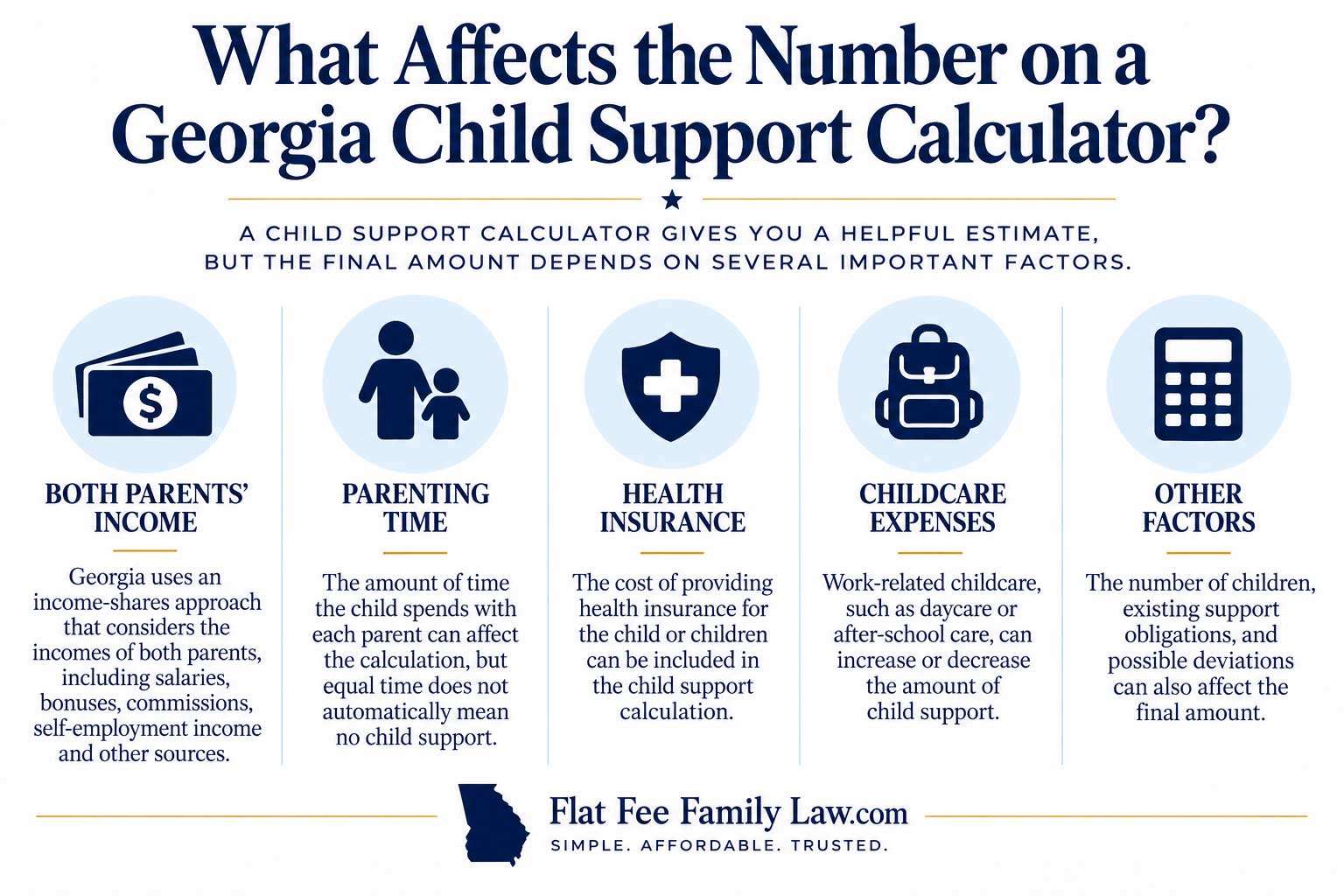
Two parents can have similar incomes and still end up with different child support amounts because income is only one part of the calculation. Parenting time, health insurance, childcare expenses, the number of children involved, and other circumstances can affect the result.
That is also why questions such as “What is the average child support payment for one child in Georgia?” often do not have a particularly useful answer. What matters more is how Georgia’s child support rules apply to the facts of your family. Understanding what affects the calculation can help you make better use of a Georgia child support calculator and recognize when a simple estimate may not tell the whole story.
What Information Do You Need for a Georgia Child Support Calculator?
Before trying to calculate child support, it helps to gather accurate information about both parents. Depending on the circumstances, that may include:
- Each parent’s gross monthly income
- Bonuses, commissions, overtime, or other compensation
- Self-employment or business income
- The number of children involved
- Parenting time
- Health insurance costs for the children
- Work-related childcare expenses
- Existing child support obligations
- Other information that may affect the calculation
The more accurate the information entered, the more useful the resulting estimate will be. If you are missing important information about the other parent’s finances, the number produced by a calculator may be very different from the amount ultimately calculated in the case.
Does Child Support Depend on Both Parents’ Income?
Yes. Georgia child support is not calculated simply by taking a percentage of the paying parent’s income. Georgia uses an income-shares approach that considers the incomes of both parents. Each parent’s proportion of their combined income helps determine that parent’s share of the child support obligation.
That makes the income figures used in the calculation particularly important. For a parent earning a regular salary, determining monthly income may be relatively straightforward. It can become more complicated when compensation includes commissions, bonuses, overtime, self-employment income, business income, or other sources of income. This is one reason a child support estimate based only on someone’s regular paycheck may not accurately reflect the eventual calculation.
How Much Is Child Support for One Child in Georgia?
There is no standard child support payment for one child in Georgia. The amount can vary significantly from one family to another because the calculation considers the parents’ financial circumstances rather than assigning a fixed dollar amount based solely on the number of children. For example, two cases involving one child could have very different results if:
- The parents have significantly different incomes
- One family has substantial childcare expenses
- One parent pays for the child’s health insurance
- The parenting arrangements are different
- One parent’s income includes bonuses or commissions
- Other adjustments or deviations apply
That is why an average child support payment for one child in Georgia is generally less useful than a calculation based on the actual circumstances of the parents and child.
Does Making More Money Always Mean Paying More Child Support?
Income is an important part of the calculation, but looking at one parent’s income by itself does not determine the result. Suppose one parent receives a significant raise. That may affect child support. But the calculation still considers the other parent’s income and the other factors that apply to the case.
The same is true when both parents earn relatively high incomes or when there is a significant difference between their incomes. Rather than asking only how much one parent earns, it is more useful to look at the financial information that goes into the entire child support calculation.
Does 50/50 Custody Mean No Child Support?
No. Equal parenting time does not automatically eliminate child support in Georgia.
Parenting time can affect child support, but it does not replace the rest of the calculation. Differences in parental income and child-related expenses can still result in one parent paying support even when parenting time is shared equally. This is one reason it can be misleading to assume that dividing parenting time equally will automatically result in a zero child support obligation. We explain this issue in more detail in Does 50/50 Custody Reduce Child Support in Georgia?
Can Childcare Increase Child Support in Georgia?
Work-related childcare can have a meaningful effect on the child support calculation. For a young child who requires full-time daycare, that expense may be substantial. Before-school care, after-school care, or other qualifying childcare expenses may also be relevant depending on the circumstances.
That means two families with identical parental incomes could still have different support calculations if one family has significant work-related childcare expenses and the other does not. When estimating child support, using accurate childcare expenses rather than ignoring them can make the estimate considerably more useful.
Does Health Insurance Affect the Child Support Calculation?
It can. The cost of providing health insurance for the children can be considered as part of the child support calculation. Who provides the coverage and the amount attributable to the children therefore may matter. Parents should distinguish the cost of coverage for the children from the total cost of a family insurance plan when gathering information for the calculation.
What If a Parent Is Self-Employed?
Self-employment can make determining income more complicated. A business owner’s taxable income is not necessarily the only number relevant to a child support calculation. Business revenue, legitimate business expenses, compensation, and other financial information may need to be considered when determining the income that should be used.
This is one area where simply entering a number into a child support calculator may not answer the underlying question. If the parents disagree about the income that should be attributed to a self-employed parent, financial records may become important to resolving that issue.
What If a Parent Gets Bonuses, Commissions, or Overtime?
Variable income can also complicate a child support calculation. Someone may have a relatively modest base salary but receive substantial commissions. Another parent may regularly work overtime. Bonuses may be paid annually rather than monthly.
The issue then becomes determining the income that should appropriately be considered rather than looking only at the parent’s most recent paycheck. Pay records, tax returns, W-2s, 1099s, and other financial documents can help establish a clearer picture of income.
What If You Don’t Know How Much the Other Parent Makes?
This is a common problem, particularly when parents maintain separate finances. You may know where the other parent works without knowing their current salary, bonuses, commissions, business income, or other compensation.
If child support is part of a court case, financial information may be obtained through required financial disclosures or discovery, depending on the circumstances. Until accurate information is available, a calculator can still be useful for testing different scenarios, but the result should be understood as an estimate rather than a definitive child support amount.
Why Does My Child Support Calculation Look Higher or Lower Than I Expected?
Sometimes parents run a calculation and are surprised by the result. That does not necessarily mean the calculator is wrong.
First, check the information entered. A mistake involving monthly versus annual income, health insurance costs, childcare expenses, parenting time, or another input can change the calculation. If the information is correct, the difference may simply reflect the fact that Georgia child support considers more than one parent’s salary. Understanding the calculation is therefore just as important as seeing the final number.
Is a Georgia Child Support Calculator the Same as What a Judge Will Order?
Not necessarily. A calculator can help estimate child support based on the information entered, but disputes can arise over the information used to perform the calculation. Parents may disagree about income, childcare expenses, insurance costs, parenting time, or whether another adjustment or deviation applies.
The calculator performs the calculation using the information provided. It does not resolve disagreements between the parents about what information should be used. That distinction can become particularly important when child support is part of a contested divorce, custody, legitimation, or modification case.
What Happens After You Calculate Child Support?
Running the numbers does not create a child support order. If you are involved in a family law case, the child support calculation may become part of the larger process of establishing custody, parenting time, financial obligations, or other issues.
For parents establishing support for the first time, What Happens After You Use the Georgia Child Support Calculator? explains what may come next. If you already have a child support order and believe the amount should change, running a new calculation also does not automatically change the existing obligation. A child support modification may be necessary.
Before You Rely on a Georgia Child Support Estimate
A child support calculator is most useful when you understand what is driving the number. Before relying on an estimate, make sure you have considered:
- Both parents’ actual income
- Variable or self-employment income
- Parenting time
- Health insurance costs
- Work-related childcare
- Existing support obligations
- Other circumstances that may affect the calculation
If one of those pieces is missing or disputed, the estimate may change once complete information becomes available.
Understanding What Your Georgia Child Support Calculation Means
A Georgia child support calculator can help answer an important question: approximately how much child support might be paid? But the more important question may be why the calculation produces that amount. Understanding the role of income, parenting time, childcare, insurance, and other factors can help you evaluate whether the information being used is accurate and what issues may need to be addressed in your case.
Brendan Dalton represents parents in child support matters arising from divorce, custody, legitimation, modification, and other family law cases throughout Georgia. Flat Fee Family Law provides flat-fee representation so clients understand the agreed legal cost before moving forward. Schedule a call today to learn more about how Flat Fee Family Law can help you with your family law needs.
Frequently Asked Questions About Georgia Child Support
What is the average child support payment for one child in Georgia?
There is no standard amount for one child. The calculation depends on the parents’ incomes, parenting time, applicable child-related expenses, and other circumstances.
How much child support will I pay in Georgia?
The amount depends on the facts used in the child support calculation. Both parents’ incomes and other applicable factors are relevant, so one parent’s salary alone generally cannot provide an accurate answer.
Can I calculate Georgia child support myself?
A Georgia child support calculator can help you estimate support if you have reasonably accurate information. The estimate may be less reliable when income or other inputs are unknown or disputed.
Does 50/50 custody mean neither parent pays child support?
No. Shared or equal parenting time does not automatically eliminate child support. Income and other factors involved in the calculation still matter.
Why is my child support estimate different from someone else’s?
Different incomes, parenting arrangements, health insurance expenses, childcare costs, and other circumstances can produce different child support calculations even for families with the same number of children.