
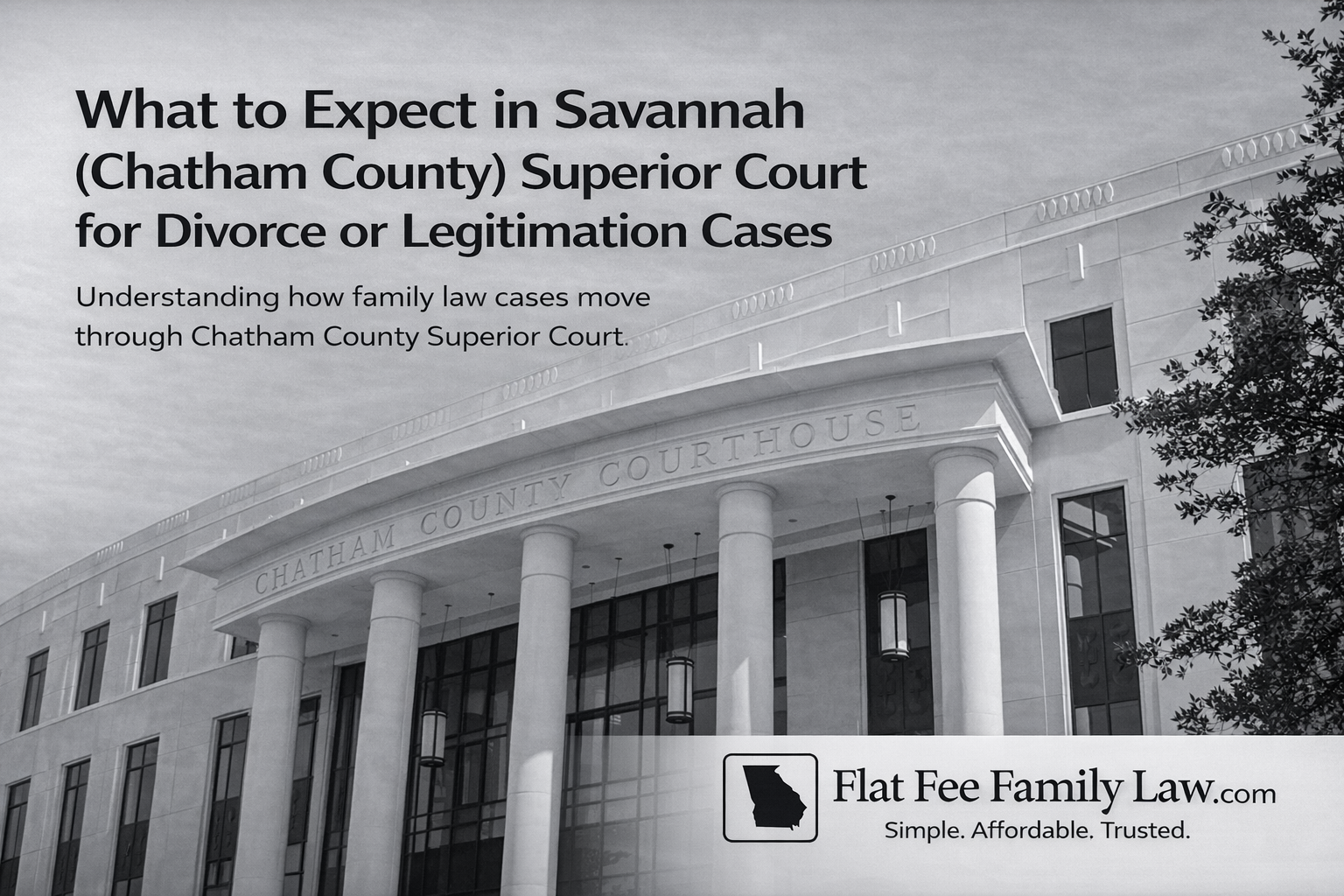
What to Expect in Savannah (Chatham County) Superior Court for Divorce or Legitimation Cases
Understanding How Family Law Cases Work in Chatham County
If you have a divorce, custody, or legitimation case in Chatham County, your case will be handled through the Superior Court of Chatham County in Savannah, Georgia.
While Georgia family law follows the same statutes statewide, how cases actually move—from filing to final hearing—can vary depending on the county. Chatham County has its own pace, courtroom expectations, and procedural nuances that can impact both timing and outcomes.
Understanding how the process typically works in Savannah can help you better prepare and avoid common issues that delay cases or create unnecessary complications.
Where Your Case Will Be Handled
Family law cases in Chatham County are handled at the Chatham County Superior Court in Savannah, GA. This court handles:
- Divorce (contested and uncontested)
- Child custody and parenting time
- Legitimation cases
- Child support and modifications
- Contempt and enforcement actions
How Divorce and Legitimation Cases Typically Move in Chatham County
While every case is different, most follow a general structure:
- Filing the Case
A divorce or legitimation case begins when one party files with the court. The other party must be formally served. - Response and Initial Filings
The responding party typically has 30 days to file an answer. In legitimation cases, this is especially important, as it can directly affect custody and parenting rights. - Financial Disclosures and Case Development
Both parties are expected to exchange financial information and begin working toward resolution. This often includes completing a Domestic Relations Financial Affidavit (DRFA). - Negotiation or Mediation
Many cases attempt to resolve through negotiation or mediation before reaching a final hearing. - Final Hearing or Trial
If no agreement is reached, the case proceeds to a final hearing where a judge will make decisions on unresolved issues.
What Makes Chatham County Different
Chatham County has some practical characteristics that people should be aware of:
A More Structured Courtroom Approach
Judges in Chatham County often expect cases to be well-organized before they reach a hearing. That includes:
- Complete financial disclosures
- Clear parenting plans
- Defined positions on key issues
If those pieces are missing, hearings can be delayed or less effective.
Preparation Matters More Than People Expect
One of the most common issues observed in Savannah cases is lack of preparation heading into hearings. Courts expect:
- Documents to be organized and accessible
- Financial numbers to be accurate and consistent
- Positions to be clearly explained
Docket Timing Can Vary
Like many courts, Chatham County can experience scheduling variability. Some cases move efficiently, while others take longer depending on:
- Court availability
- Complexity of the case
- Level of conflict between parties
Common Mistakes That Can Slow a Case Down
The most common issues observed in Chatham County cases include:
- Failing to complete financial disclosures accurately
- Taking unrealistic or unsupported positions in negotiations
- Submitting vague or incomplete parenting plans
- Waiting too long to prepare for hearings
- Not understanding what the court expects before appearing
These are issues seen not just in Savannah, but across Georgia—but they can have a direct impact on how quickly (and effectively) your case moves in this court.
What Judges Typically Focus On
In both divorce and legitimation cases, judges are focused on:
- Credibility and consistency of each party
- Best interests of the child in custody-related matters
- Clarity of financial information when determining support
- Reasonableness of each party’s position
The court is not looking for perfection—but it does expect preparation and clear, supported positions.
How Chatham County Compares to Other Metro Georgia Courts
While the legal standards are the same across Georgia, the experience can differ depending on the county:
- Fulton County (Atlanta): Higher volume, often faster-paced with more crowded dockets
- Cobb County (Marietta): Structured and detail-oriented, with a strong emphasis on preparation
- Gwinnett County (Lawrenceville): Efficient, but often strict on procedural compliance
- Henry County (McDonough): Typically more streamlined, but still expects organized and complete filings
- Newton County (Covington): Can move more deliberately, where preparation and responsiveness play a key role in keeping cases on track
Understanding these differences can help set expectations depending on where your case is filed.
Preparing for a Final Hearing in Savannah
If your case is heading toward a final hearing, preparation becomes critical. That includes:
- Having all required financial documents completed and accurate
- Understanding your parenting plan and being able to explain it clearly
- Knowing what issues are still unresolved
- Being ready to present your case in an organized and focused way
This is often where cases are ultimately decided—especially when agreements are not reached beforehand.
Questions About How Your Case Will Move Through Chatham County?
Understanding how divorce or legitimation cases work in Chatham County is one thing. Knowing how the court process, timelines, and expectations apply to your specific situation—especially when custody, financial issues, or disagreements are involved—is where things become more complex.
Flat Fee Family Law represents clients across Georgia in divorce, custody, and legitimation cases, including those involving hearings in Chatham County Superior Court.
Schedule a consultation with our attorney, Brendan Dalton, to discuss your situation and next steps and learn how Flat Fee Family Law can support you in your family law matter.
Frequently Asked Questions
What should I expect at a divorce hearing in Chatham County?
At a divorce hearing in Chatham County Superior Court, the judge will review any unresolved issues such as property division, child custody, and support. Each side may present testimony and evidence. The court expects organized financial information, clear positions, and a focused presentation of the issues.
How long does a divorce take in Savannah, Georgia?
The timeline for a divorce in Savannah can vary depending on whether the case is contested or uncontested. Uncontested cases may be resolved in a few months, while contested cases—especially those involving custody or complex finances—can take significantly longer depending on court scheduling and preparation.
What happens at a legitimation hearing in Chatham County?
In a legitimation case, the court determines the father’s legal rights, including custody and parenting time. The judge will consider the child’s best interests, the father’s involvement, and the overall circumstances of the case. Preparation and clear documentation are important in these hearings.
What documents do I need for a divorce case in Chatham County?
Most divorce cases require financial disclosures, including a Domestic Relations Financial Affidavit (DRFA), income information, and documentation of expenses, assets, and debts. If children are involved, a proposed parenting plan is also typically required.
How can I prepare for court in Chatham County Superior Court?
Preparation includes organizing your financial documents, understanding your position on key issues, and being ready to clearly explain your case. Courts expect parties to be prepared, responsive, and focused on resolving the issues before them.
What do judges look for in custody cases in Savannah?
Judges focus on the best interests of the child, including each parent’s involvement, stability, and ability to meet the child’s needs. Consistency, credibility, and a well-developed parenting plan can play a significant role in how decisions are made.
Can a case be resolved without going to a final hearing?
Yes. Many cases in Chatham County are resolved through negotiation or mediation before reaching a final hearing. Reaching an agreement can save time, reduce costs, and allow both parties more control over the outcome.