
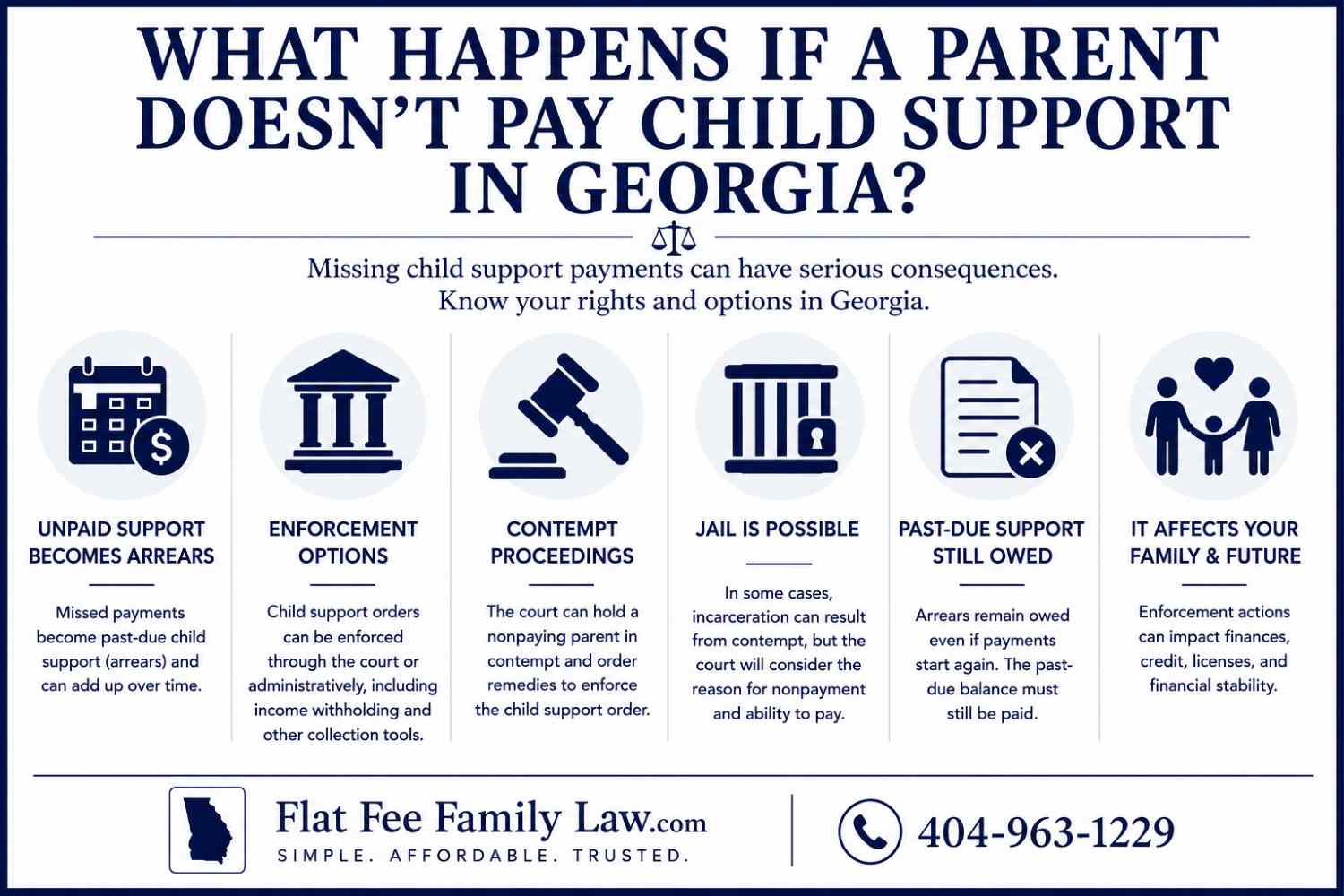
What Happens If a Parent Doesn’t Pay Child Support in Georgia?
When a Georgia court orders a parent to pay child support, that obligation is not optional. If payments are missed, unpaid child support can accumulate and the parent who is owed support may have several options for enforcing the existing child support order.
At the same time, falling behind on child support does not always mean a parent is simply refusing to pay. Job loss, reduced income, illness, or other significant financial changes can make an existing child support obligation difficult to meet. The important thing to understand is that a parent generally cannot simply decide to reduce or stop court-ordered child support because circumstances have changed.
Understanding how child support enforcement in Georgia works can help both parents determine what steps may be appropriate when payments are not being made as ordered.
What Happens When Child Support Isn’t Paid in Georgia?
When a parent fails to make a required child support payment, the unpaid amount generally becomes past-due child support, often referred to as child support arrears. Those missed payments can accumulate over time. Making future payments does not necessarily eliminate the balance that has already become due.
For example, if a parent is ordered to pay $1,000 per month but pays only $500, the remaining $500 does not simply disappear. Continued underpayment can result in a growing arrearage. The parent who is supposed to receive support may seek enforcement of the existing order.
How Can a Child Support Order Be Enforced in Georgia?
There are different ways child support orders may be enforced in Georgia depending on the circumstances. One option may be asking the court to enforce the order through a contempt proceeding. Child support may also be subject to administrative enforcement mechanisms, including income withholding and other collection measures available under Georgia law. Depending on the circumstances, enforcement may involve court proceedings, income withholding, collection of past-due support, or other remedies authorized under Georgia law. The appropriate approach can depend on factors such as:
- The language of the existing child support order
- How much support has not been paid
- How long payments have been delinquent
- Whether payments have been made inconsistently or only partially
- The reason the paying parent has fallen behind
- Whether there are disputes about the amount actually owed
Good payment records can become particularly important when enforcement is disputed.
Can a Parent Be Held in Contempt for Not Paying Child Support?
Potentially.
When child support is established by a court order and a parent fails to comply with that order, the other parent may ask the court to hold the nonpaying parent in contempt. A contempt case is not simply about establishing that a payment was missed. The circumstances surrounding the failure to comply can matter, including the parent’s ability to pay.
If the court finds contempt, it can impose remedies designed to enforce compliance with the child support order. Because contempt proceedings can carry significant consequences, both parents should take them seriously.
Can You Go to Jail for Not Paying Child Support in Georgia?
In some circumstances, incarceration can be a consequence of contempt involving unpaid child support, but simply missing a payment does not mean a parent is automatically sent to jail. The circumstances matter.
A court may consider why the support was not paid, the parent’s financial circumstances, ability to comply with the order, and other evidence presented during the proceeding. This is one reason a parent facing a child support contempt action should not ignore the case or assume that explaining the situation informally will resolve it.
What Happens to Past-Due Child Support?
Past-due child support can become a significant financial issue when missed payments accumulate over months or years. A parent who begins making regular payments again may still owe the arrearage that accumulated while payments were missed.
Disputes can also arise over exactly how much is owed. Parents may disagree about payments made directly, credits they believe should apply, or the calculation of the outstanding balance. Keeping documentation of child support payments—including dates, amounts, and payment methods—can therefore be important for both parents.
What If You Can’t Afford Your Current Child Support Payment?
A substantial change in financial circumstances may provide grounds to seek a modification of child support, but the existing order generally remains in effect unless and until it is legally modified. That distinction is important.
Losing a job, earning less money, or experiencing another financial setback does not automatically change the amount required by an existing child support order. Waiting can also create a larger problem because unpaid amounts may continue accumulating while the existing order remains in place. If your financial circumstances have significantly changed, understanding whether you may qualify for a child support modification in Georgia can be an important step before arrears become more difficult to address.
Can You Stop Paying Child Support If the Other Parent Violates the Parenting Plan?
Generally, parents should not treat child support and parenting time as interchangeable obligations. If one parent is interfering with court-ordered parenting time, that may need to be addressed through appropriate legal procedures. It does not ordinarily give the other parent the right to simply stop complying with a child support order.
Likewise, failure to pay child support does not generally authorize the other parent to disregard an existing custody or parenting-time order. When either parent is violating a court order, the better approach is usually to address the specific violation rather than creating an additional one.
What Should You Do If Your Ex Isn’t Paying Child Support?
If court-ordered child support is not being paid, start by gathering accurate information. Keep records showing:
- Payments that were due
- Payments actually received
- Dates and amounts of partial payments
- Payment records or account statements
- Relevant communications about missed payments
- A copy of the current child support order
It can also be helpful to determine the total amount you believe is outstanding before pursuing enforcement. From there, you can evaluate the available options for enforcing the existing order and determine whether court action may be appropriate.
What If You Are the Parent Who Has Fallen Behind?
Ignoring unpaid child support usually does not make the problem easier to resolve. If you have fallen behind, determine how much is allegedly owed, compare that amount with your own payment records, and review the current order carefully.
If your financial circumstances have materially changed, consider whether you may have grounds to seek a modification rather than allowing additional unpaid support to accumulate. A modification and an enforcement action are different legal issues. Requesting a lower support obligation going forward does not necessarily eliminate support that became due under the existing order.
Georgia Child Support Enforcement and Contempt Representation
Child support disputes can become complicated quickly, particularly when significant arrears have accumulated or a contempt action has been filed. Whether you are trying to enforce an existing child support order or responding to allegations that you have failed to pay, understanding the order, the payment history, and the available legal options is important before deciding how to proceed.
At Flat Fee Family Law, Brendan C. Dalton provides flat-fee representation across Georgia family law matters, including child support disputes, modifications, and contempt proceedings. Flat-fee representation allows clients to understand the cost of legal representation upfront rather than receiving ongoing hourly legal bills as a case progresses. If you are experiencing an issue around child support payments and have questions about next steps, schedule a consultation with Flat Fee Family Law to discuss your situation.
Frequently Asked Questions About Unpaid Child Support in Georgia
What happens if you don't pay child support in Georgia?
Unpaid child support can accumulate as arrears, and the parent owed support may pursue enforcement of the existing court order. Depending on the circumstances, enforcement can include contempt proceedings and other collection mechanisms.
Can my ex take me back to court for unpaid child support?
If you are not complying with a court-ordered child support obligation, the other parent may seek court enforcement, including potentially filing a contempt action.
Can you go to jail for unpaid child support in Georgia?
Incarceration can be a potential consequence in some child support contempt proceedings, but it is not automatic simply because a payment was missed. The court considers the circumstances of the alleged failure to comply with its order.
Does past-due child support go away if I start paying again?
Beginning to make current payments does not necessarily eliminate child support arrears that have already accumulated.
Can child support be lowered if I lose my job?
A significant change in income may provide grounds to request a child support modification, but the existing court order does not automatically change when a parent’s financial circumstances change.