
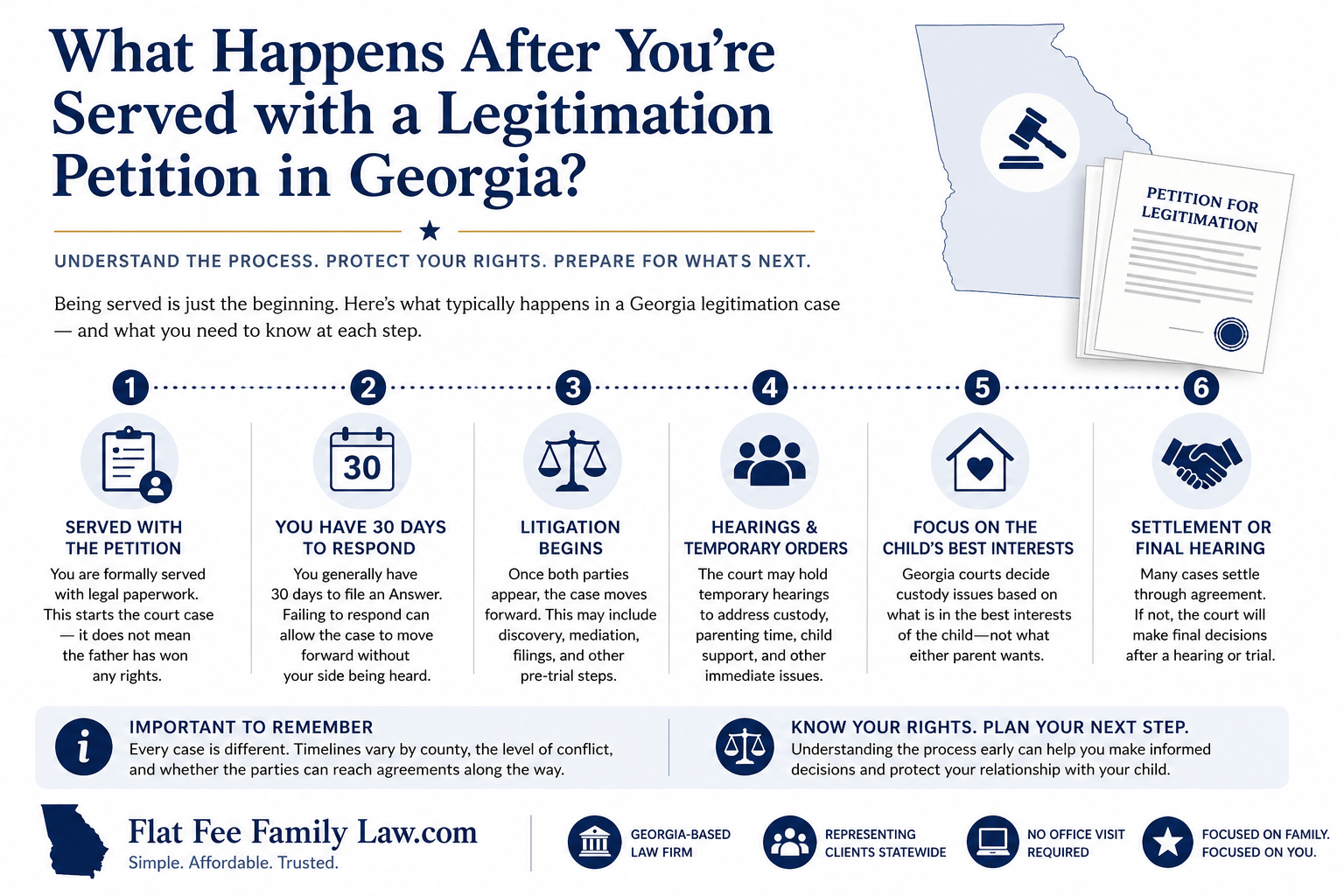
What Happens After You’re Served with a Legitimation Petition in Georgia?
Being served with a legitimation petition in Georgia can feel overwhelming — especially if you were not expecting legal action involving custody, visitation, or parental rights. Many mothers receive legitimation paperwork without understanding what it means, how quickly they need to respond, or what rights the father is actually requesting from the court.
The good news is that being served with a legitimation petition does not automatically change custody, parenting time, or decision-making authority. The case is simply beginning, and what happens next depends heavily on how the case is handled from the start.
What Is a Legitimation Case in Georgia?
Under Georgia law, unmarried fathers do not automatically receive legal rights to a child simply because they are listed on the birth certificate or have been involved in the child’s life. A father must typically file a legitimation action to ask the court for legal parental rights. Legitimation cases are commonly filed alongside requests for:
- Custody
- Visitation or parenting time
- Child support
- Decision-making authority
- Name changes
In many cases, the father is asking the court to legally recognize him as the child’s father while also requesting some form of custodial or visitation rights.
If you want a broader overview of how these cases work, our new Georgia Legitimation Guide provides a more detailed breakdown of the overall process, timelines, and related custody issues.
Step One: Being Served with the Petition
The first formal step is service of process. This usually occurs when a sheriff’s deputy or private process server personally delivers the legal paperwork. The documents often include:
- Petition for Legitimation
- Summons
- Verification
- Proposed Parenting Plan
- Other custody-related filings
Many people panic when they are served because the paperwork can look intimidating. However, service itself does not mean the father has already won custody or visitation rights. It simply means the court case has officially started.
If you’ve been served, our What To Do if You’ve Been Served resource may be a helpful starting point to understand what service means and how to get organized and respond.
How Long Do You Have to Respond?
In Georgia, you generally have 30 days to file an Answer after being served.
Failing to respond can create serious problems because the court may proceed without hearing your side of the case. While every situation is different, ignoring the petition is almost never a good idea. The response may involve:
- Admitting or denying allegations
- Addressing custody claims
- Responding to visitation requests
- Raising concerns about the child’s best interests
- Filing counterclaims when appropriate
Some cases are relatively straightforward. Others become heavily contested very quickly.
What Happens After the Answer Is Filed?
Once both parties have appeared in the case, the litigation phase begins. This is where many parents realize legitimation cases are often much more involved than they expected. Depending on the county and the issues involved, the case may include:
- Temporary hearings
- Mediation
- Discovery requests
- Financial disclosures
- Parenting plan disputes
- Custody evaluations
- Guardian ad litem involvement
- Negotiations between attorneys
- Final hearings or trial
The timeline can vary substantially depending on the level of conflict between the parties and the court’s schedule.
Temporary Hearings in Legitimation Cases
In some cases, one party requests a temporary hearing early in the process. Temporary hearings are designed to address immediate issues while the case is pending, such as:
- Temporary custody
- Temporary parenting time
- Child support
- Communication rules
- Exchanges and transportation
- Temporary restrictions or conditions
The court’s temporary order is not necessarily the final outcome of the case, but it can significantly affect how the case develops moving forward.
The Court Focuses on the Child’s Best Interests
Georgia courts decide custody-related issues using the “best interests of the child” standard. That means the court is not automatically “for” or “against” either parent. Instead, the judge evaluates factors such as:
- Stability of the child’s environment
- Existing parent-child relationships
- Ability to care for the child
- Communication and co-parenting concerns
- School and community involvement
- History of caregiving
- Safety concerns
- Overall parental fitness
In contested legitimation cases, documentation, communication history, and preparation often matter far more than emotions or accusations alone.
Can the Parents Reach an Agreement?
Yes. Many legitimation cases eventually settle through negotiation or mediation. When parents can reach workable agreements regarding custody and parenting schedules, the process is often faster, less stressful, and less expensive than full litigation. However, settlement is not always possible — particularly when there are major disagreements involving:
- Custody
- Relocation
- Parenting time
- Safety concerns
- Communication issues
- Decision-making authority
In those situations, the court may ultimately need to decide the unresolved issues after a hearing or trial.
What Makes Legitimation Cases Complicated?
One of the biggest misconceptions is that legitimation cases are “simple paperwork.” In reality, these cases can become highly contested because they directly involve parental rights and custody issues. Complications commonly arise when:
- Parents were never in a long-term relationship
- Communication has broken down
- One parent has had primary caregiving responsibilities
- There are disagreements about the child’s schedule
- One parent is largely absent
- Relocation becomes an issue
- New partners or blended family dynamics create tension
- Financial disputes overlap with custody disputes
Because of this, early strategy and preparation often matter significantly.
How Georgia Counties Can Handle Legitimation Cases Differently
Although Georgia family law is statewide, court procedures and scheduling can vary significantly by county. Some counties move cases faster than others. Some require mediation earlier in the process. Others have crowded calendars that can extend timelines substantially.
Metro Atlanta counties like Fulton, DeKalb, Cobb, and Gwinnett often handle large volumes of family law litigation, which can affect scheduling and hearing timelines differently than smaller counties. Understanding local court expectations can become important as the case progresses.
Common Mistakes After Being Served
People sometimes make decisions immediately after service that unintentionally hurt their case later. Common mistakes include:
- Ignoring the paperwork
- Missing response deadlines
- Sending hostile text messages
- Withholding the child without legal advice
- Posting about the case on social media
- Refusing reasonable communication
- Assuming the case will “go away”
Even when emotions are high, it is usually better to approach the process carefully and strategically rather than react impulsively.
Legitimation Cases Often Involve Long-Term Parenting Issues
One important thing many parents overlook is that legitimation cases are not just about the next few weeks or months. The outcome can affect:
- Parenting schedules
- Holiday schedules
- Decision-making rights
- School involvement
- Medical decisions
- Relocation issues
- Child support obligations
- Future co-parenting dynamics
That is why many parents take these cases seriously from the beginning rather than waiting for problems to escalate.
Final Thoughts
Being served with a legitimation petition in Georgia does not mean custody has automatically changed or that the court has already decided the outcome. It means a legal process has started — one that may involve custody, parenting time, child support, and long-term parental rights. Understanding the process early can help parents avoid common mistakes and better prepare for what comes next.
At Flat Fee Family Law, attorney Brendan Dalton represents clients throughout Georgia in legitimation, custody, and contested family law matters. If you have been served with a legitimation petition in Georgia and want to better understand your options, scheduling a call can help you better prepare for the court process, understand the issues involved in your case, and avoid common mistakes early in the litigation process.
FAQs
Does being served with a legitimation petition mean the father automatically gets custody?
No. Being served only means the case has been filed. The court has not yet decided custody or visitation issues.
Can a father get visitation rights through legitimation?
Yes. Legitimation cases commonly involve requests for parenting time or visitation rights in addition to legal recognition of parental rights.
How long does a legitimation case take in Georgia?
It varies significantly depending on the county, level of conflict, court scheduling, and whether the parties reach agreements.
Do I have to go to court in a legitimation case?
Some cases settle through negotiation or mediation, while others require hearings or trial.
Can unmarried fathers file for custody in Georgia?
Typically, fathers first pursue legitimation before seeking full custodial rights through the court.
What happens if I ignore the legitimation paperwork?
Failing to respond can create serious legal problems and may allow the case to move forward without your participation.