
How Much Child Support Will I Pay in Georgia? (Real Examples)
One of the most common questions parents ask during a Georgia divorce, legitimation, custody, or child support case is:
“How much child support will I have to pay?”
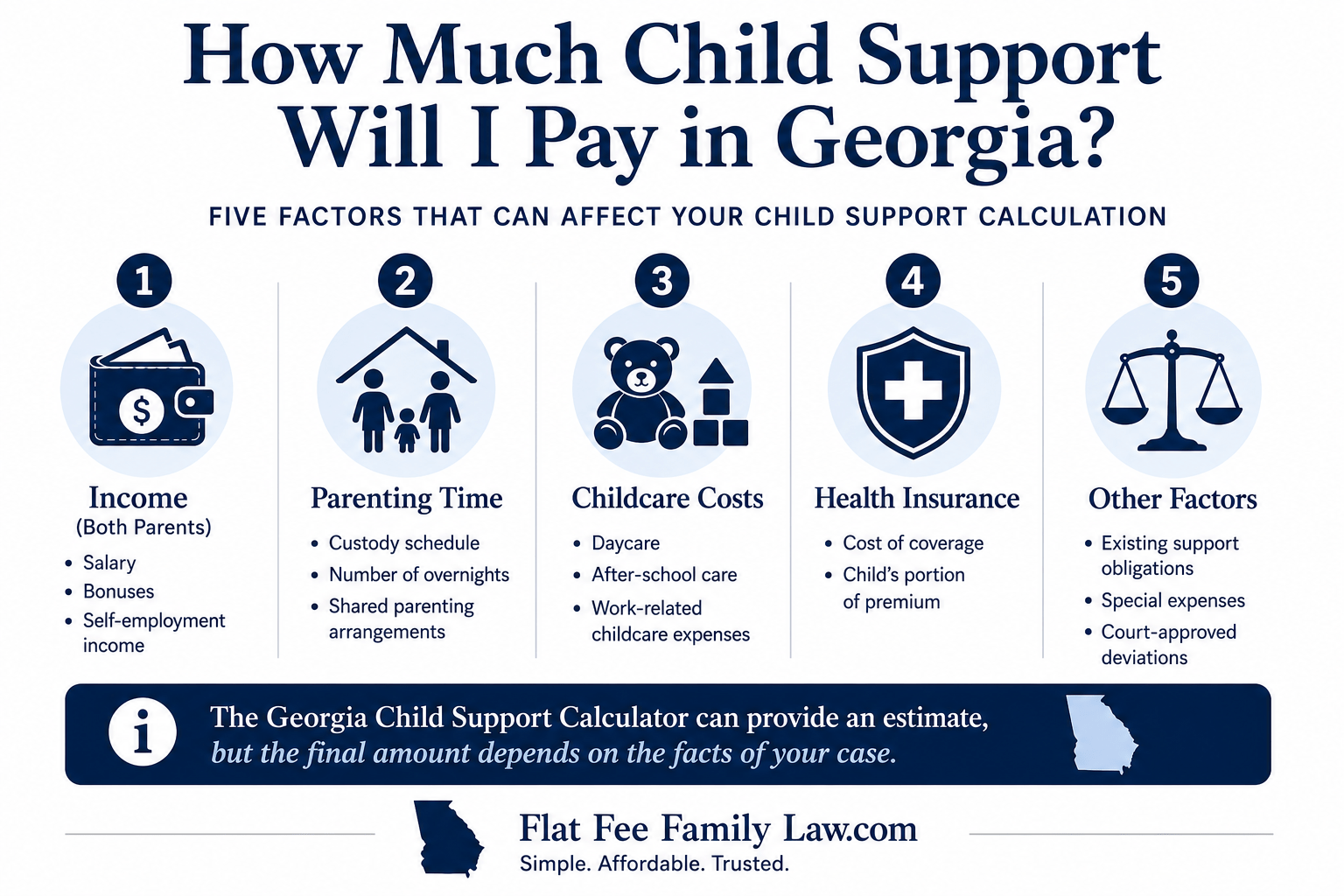
The answer depends on several factors, including both parents’ incomes, parenting time arrangements, childcare expenses, and health insurance costs. While Georgia uses a formula to calculate child support, the final amount is based on the specific facts of each family’s situation.
If you are trying to estimate what child support may look like in your case, our Georgia Child Support Basics and Georgia Child Support Calculator resources can provide a useful starting point. Understanding how the calculation works, however, is just as important as knowing the final number. In this article, we’ll walk through several realistic examples and explain why child support amounts can vary significantly from one family to another.
How Child Support Is Calculated in Georgia
Georgia uses what is known as the “income shares” model for child support. The goal is to estimate the amount parents would have spent on their child if they were still living together and then divide that responsibility between the parents based on their respective incomes. A child support calculation may consider:
- Each parent’s gross monthly income
- The number of children involved
- Health insurance costs for the child
- Work-related childcare expenses
- Parenting time arrangements
- Existing child support obligations
- Certain allowable deductions
- Other expenses recognized under Georgia law
Because several variables are involved, two families with similar incomes may end up with very different child support obligations. For a more detailed explanation of the calculation process, see our guide on how child support is calculated in Georgia.
Example 1: One Child and Moderate Incomes
Assume the following:
- Parent A earns $6,000 per month
- Parent B earns $4,000 per month
- There is one child
- Parent B has primary physical custody
Together, the parents have a combined monthly income of $10,000.
Because Parent A earns approximately 60 percent of the combined income, Parent A will generally be responsible for approximately 60 percent of the child support obligation calculated under Georgia’s guidelines.
The resulting support payment could easily be several hundred dollars per month, although the exact amount would depend on the complete worksheet and any adjustments that apply.
Example 2: Higher-Income Parents
Now assume:
- Parent A earns $10,000 per month
- Parent B earns $8,000 per month
- There is one child
The combined monthly income is now $18,000.
Because the child support guidelines are based in part on combined parental income, the presumptive support amount will generally be higher than in the previous example.
Even when the percentage allocation between the parents remains similar, the overall obligation often increases as income increases. This is one reason why accurately reporting financial information and determining income can become a significant issue in contested family law cases.
Example 3: Equal Parenting Time
Many parents believe that a 50/50 parenting schedule automatically eliminates child support. In Georgia, that is not necessarily true.
Assume:
- Parent A earns $8,000 per month
- Parent B earns $4,000 per month
- The parties share equal parenting time
Even with equal parenting time, the court may still order child support because of the significant difference in income between the parents. Parenting time is an important factor, but it is only one part of the overall calculation.
Example 4: Childcare Expenses
Now let’s return to the first example and add one additional fact:
- Work-related childcare costs are $1,200 per month
Childcare expenses can substantially affect the child support calculation. When daycare or other childcare expenses are necessary because a parent is working, those costs may be included in the child support worksheet and allocated between the parents. For families with younger children, childcare expenses are often one of the most significant variables affecting support.
Example 5: Health Insurance Costs
Assume Parent A pays:
- $300 per month for the child’s health insurance coverage
Georgia’s child support guidelines account for health insurance costs attributable to the child. The parent paying those costs may receive a credit or adjustment within the worksheet. As a result, support calculations that do not accurately account for health insurance expenses may produce misleading estimates.
Why Child Support Estimates Often Change
Parents are frequently surprised when an initial child support estimate changes during a case. In many situations, this happens because additional information becomes available after the case begins. Common reasons include:
- Updated income documentation
- Overtime or bonus income
- Self-employment earnings
- Revised parenting schedules
- Childcare expenses
- Health insurance costs
- Discovery responses
- Additional financial records
- Deviations requested by one of the parties
As more accurate information becomes available, the worksheet may need to be updated. This is why a child support calculator should generally be viewed as a starting point rather than a final answer.
What Happens if Income Changes Later?
A significant change in financial circumstances may justify a future modification of child support. Examples may include:
- Job loss
- Significant increases in income
- Disability
- Retirement
- Changes in business income
However, child support does not automatically change when circumstances change. The existing order generally remains enforceable until a court approves a modification.
Common Misconceptions About Child Support
“We Have 50/50 Custody, So Nobody Pays Child Support.”
Not necessarily. A parent may still owe child support even when parenting time is shared equally.
“Child Support Is Based Only on Income.”
No. Childcare expenses, health insurance costs, parenting time, and other factors can affect the calculation.
“The Calculator Gives the Final Number.”
A calculator provides an estimate based on the information entered. The final amount may change as additional information becomes available.
“The Judge Must Accept the Guideline Amount.”
Georgia courts generally begin with the guideline calculation, but judges may approve deviations in appropriate circumstances.
Using Child Support Estimates Effectively
Child support estimates can be helpful when:
- Evaluating settlement options
- Preparing for mediation
- Planning a budget after separation
- Negotiating custody arrangements
- Responding to a legitimation action
The more accurate the information used, the more useful the estimate will be. That is why attorneys often update child support worksheets throughout a case as new information becomes available.
Final Thoughts
There is no single answer to the question, “How much child support will I pay in Georgia?”
The amount depends on income, parenting time, childcare expenses, health insurance costs, and other facts unique to your family. While Georgia’s child support formula provides structure and predictability, small changes in the underlying information can sometimes have a meaningful impact on the final result.
If you are trying to estimate child support, start by using our Georgia Child Support Calculator Guide and reviewing our child support basics overview. Together, these resources can help you better understand the process and set realistic expectations before negotiations, mediation, or court proceedings begin.
At Flat Fee Family Law, Brendan Dalton helps clients throughout Georgia navigate child support issues in divorce, legitimation, custody, and modification cases. If you have questions about your situation, schedule a call to discuss your options and learn more about our flat-fee family law services.
FAQs
How much child support will I pay for one child in Georgia?
There is no fixed amount. Georgia calculates child support using both parents’ incomes, parenting time arrangements, childcare expenses, health insurance costs, and other relevant factors.
Does 50/50 custody eliminate child support in Georgia?
No. A parent may still owe child support even when parenting time is shared equally.
Can child support change during a case?
Yes. Updated financial information, parenting schedules, childcare costs, and other factors can affect the calculation.
Is the Georgia Child Support Calculator accurate?
The calculator can provide a useful estimate, but the result depends on the accuracy of the information entered.
Can a judge order a different amount than the calculator suggests?
In some circumstances, yes. Georgia courts may approve deviations from the guideline amount when permitted by law.