
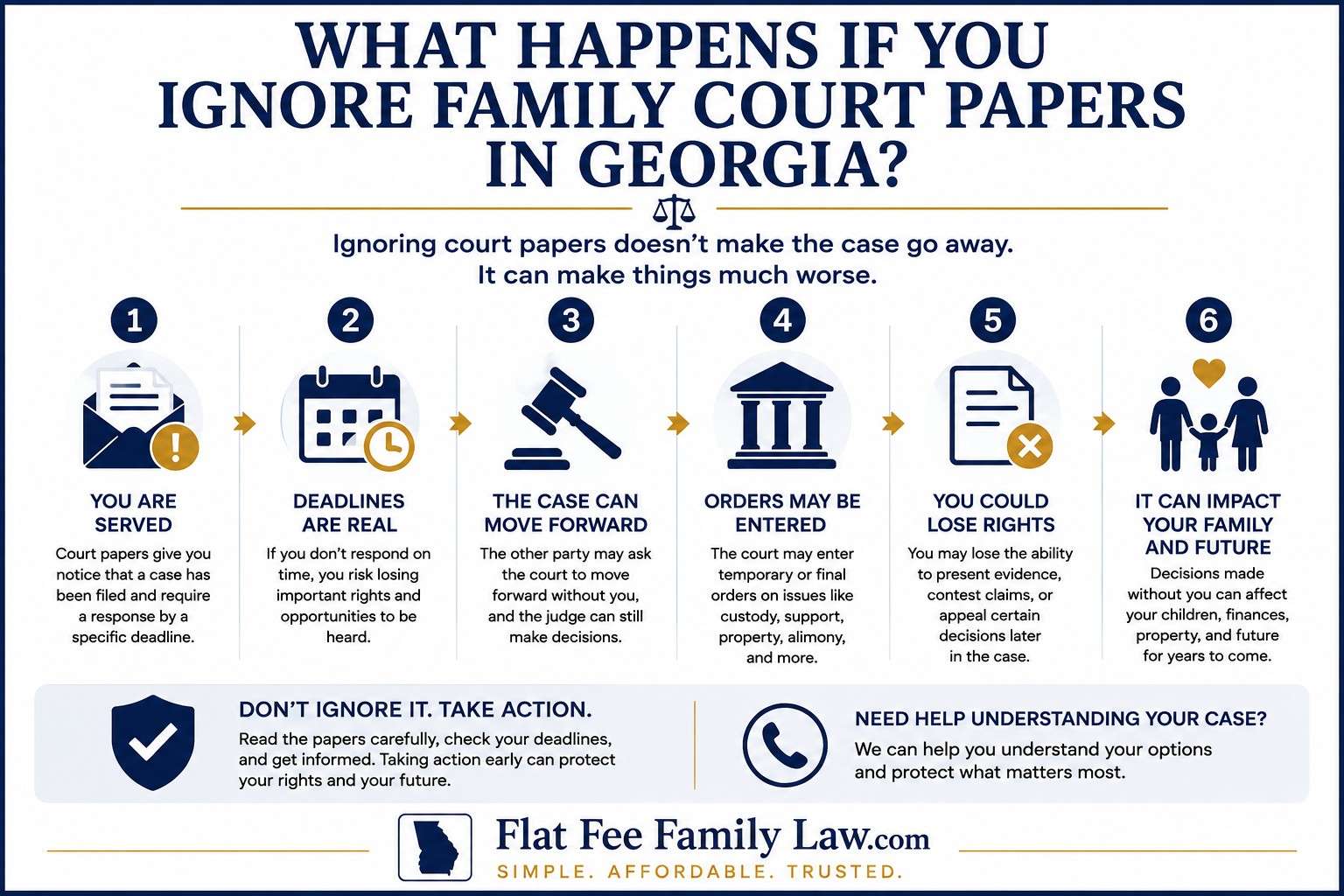
What Happens If You Ignore Family Court Papers in Georgia?
Receiving family court papers can be stressful, especially when the documents involve a divorce, child custody dispute, child support case, legitimation action, contempt proceeding, or another important family matter.
Some people delay responding because they are overwhelmed, believe the other party will not move forward, or assume that refusing to participate will prevent the case from proceeding. Unfortunately, ignoring family court papers generally does not make the case go away.
If you have been served with family court papers in Georgia, deadlines may apply and the court may be able to move forward even if you do not participate. Understanding what the papers mean and taking action early can help protect your ability to respond and present your position to the court.
What Does It Mean to Be Served With Family Court Papers?
Service is the formal process used to provide notice that a legal action has been filed against you. Depending on the type of family law case, the documents you receive may include a:
- Complaint for Divorce
- Petition for Legitimation
- Petition to Modify Custody or Child Support
- Petition for Contempt
- Motion or other request for court action
- Summons
- Notice of hearing
- Discovery requests
The documents should be reviewed carefully because different papers can create different obligations and deadlines. Being served does not mean the other party automatically gets everything they requested. It means a legal proceeding has begun and you have been given notice and an opportunity to participate.
Can You Ignore Family Court Papers in Georgia?
You can choose not to respond, but doing so can have serious consequences. A family law case generally does not stop simply because one party refuses to participate. Depending on the type of case and its procedural posture, the other party may continue pursuing the relief requested from the court.
That can leave the court considering important issues without having your evidence, explanations, or objections in front of it. For example, the court could potentially be asked to address issues involving:
- Divorce
- Division of marital property and debts
- Child custody
- Parenting time
- Child support
- Alimony
- Legitimation
- Modification of an existing order
- Enforcement of an existing order
The consequences depend on the particular case, but ignoring properly served court papers is rarely an effective strategy.
What Happens If You Do Not Answer a Divorce Complaint in Georgia?
When someone files a divorce action, the other spouse generally has an opportunity to file an answer and respond to the allegations and requests contained in the complaint. Failing to respond does not prevent the divorce from proceeding.
Depending on the circumstances, the filing spouse may eventually ask the court to move forward without the responding spouse actively participating in the case. This can be especially significant in a contested divorce involving questions about property, debts, alimony, custody, parenting time, or child support.
Even if you do not want the divorce, refusing to respond generally does not give you the ability to stop the other spouse from pursuing it.
Can a Georgia Family Court Enter a Default Judgment?
Default can become an issue when a party who has been properly served fails to respond as required. However, family law cases can be more complicated than ordinary civil lawsuits. The court may still need evidence before deciding certain issues, particularly matters involving children.
For that reason, being in default should not be understood as automatically giving the filing party everything requested. It does mean, however, that the nonresponding party may lose important procedural protections and make it considerably more difficult to defend the case.
If you believe a deadline has already passed, it may still be important to determine the status of the case rather than assuming nothing can be done.
What If You Ignore a Notice of Hearing?
A notice of hearing is particularly important because it tells you that the court intends to consider an issue at a specific date and time. Failing to attend a properly noticed hearing does not necessarily prevent the hearing from taking place.
Depending on the circumstances, the judge may hear evidence from the party who appears and enter an order based on the information presented. A hearing could involve significant issues such as:
- Temporary custody
- Parenting time
- Temporary child support
- Temporary alimony
- Use of the marital home
- Attorney’s fees
- Contempt allegations
- Modification of an existing order
- Final resolution of certain issues
If you receive a hearing notice, review it immediately and determine what the hearing concerns and what preparation may be required.
What Happens If You Ignore Discovery Requests?
Not every document requiring action comes directly from the judge. During a contested family law case, one party may serve the other with discovery requests seeking documents, written answers, admissions, or other information relevant to the case. Discovery can include:
- Interrogatories
- Requests for Production of Documents
- Requests for Admissions
- Depositions
- Subpoenas
Ignoring discovery requests can create additional problems. The requesting party may ask the court to compel responses, and continued failure to comply can potentially result in sanctions or other consequences.
Requests for admissions deserve particular attention because failing to respond within the applicable deadline may result in matters being deemed admitted, subject to Georgia law and the circumstances of the case.
If you receive discovery, do not assume it can be ignored simply because the documents came from the other attorney rather than directly from the court.
What If You Have Already Missed the Deadline?
Missing a deadline does not mean you should continue ignoring the case. In fact, additional delay can make the situation more difficult. If you discover that a response was due several days or weeks ago, you should determine:
- What documents were served
- When service occurred
- What deadline applied
- Whether anything has been filed since then
- Whether a hearing has been scheduled
- Whether an order has already been entered
The options available will depend on the type of case and how far the proceedings have progressed. The important point is that missing one deadline is not a reason to miss the next one.
What If You Do Not Understand the Papers?
Family court documents can be confusing. A packet may contain a summons, petition, standing order, financial forms, notices, and other documents that are difficult to understand if you have never been involved in a court case.
Do not assume a document is unimportant simply because you do not understand it. Start by identifying:
- Who filed the case.
- What type of case was filed.
- What the other party is asking the court to do.
- When you were served.
- Whether a response deadline is listed.
- Whether a hearing has already been scheduled.
An attorney can review the documents and help you understand what actions may be necessary.
What Should You Do After Being Served With Family Court Papers?
The period immediately after service is an important time to get organized. Keep every document you received, including envelopes or service paperwork. Make a note of the date you were served and review the documents for deadlines and hearing dates.
You should also begin gathering information that may relate to the case. Depending on the issues involved, that could include financial records, communications, parenting schedules, court orders, property records, or other relevant documents.
Most importantly, do not wait until shortly before a deadline or hearing to determine how you intend to respond. Early preparation provides more time to understand the allegations, identify important evidence, and determine the appropriate response.
Do You Need an Attorney After Being Served?
Georgia law does not require every person involved in a family law case to hire an attorney. However, family court orders can affect your finances, property, and relationship with your children for years.
The more significant or contested the issues are, the more important it can be to understand your rights and obligations before responding. Legal representation may be particularly valuable when a case involves:
- Contested child custody
- Significant marital assets or debts
- Child support disputes
- Alimony
- Allegations of misconduct
- Contempt
- Modification of an existing custody or support order
- Upcoming hearings
- Missed deadlines
Even when you are unsure whether you need full representation, having an attorney review the papers can help you understand what you are facing.
Served With Family Court Papers in Georgia? Do Not Ignore Them
Being served with family court papers does not mean you have lost your case. Ignoring those papers, however, can limit your options and allow the case to move forward without your position being fully presented. The best first step is to understand exactly what was filed, identify any applicable deadlines, and determine what response may be appropriate.
Brendan Dalton represents clients throughout Georgia in divorce, child custody, legitimation, child support, modification, contempt, and other family law matters. If you have been served with family court papers or have already missed a deadline, contact Flat Fee Family Law to schedule a consultation.
FAQs
What happens if I do not respond to family court papers in Georgia?
The case may continue even if you do not respond. Depending on the type of proceeding, failing to participate can affect your ability to contest allegations, present evidence, or oppose the relief requested by the other party.
Can my spouse get a divorce if I refuse to respond?
Potentially, yes. Refusing to respond generally does not prevent the other spouse from pursuing a divorce in Georgia.
What happens if I miss a family court hearing?
The court may be able to proceed without you if you received proper notice. The judge may hear evidence from the party who appears and potentially enter orders affecting issues such as custody, support, property, or contempt.
What should I do if I already missed my deadline to respond?
Do not continue ignoring the case. Determine what was filed, when you were served, whether a hearing has been scheduled, and whether any additional documents or orders have been entered. An attorney can help determine what options may still be available.
Do I have to respond to discovery from the other attorney?
Discovery requests can carry legal deadlines even though they come from the opposing party or attorney rather than directly from the judge. Failing to respond can lead to motions to compel, potential sanctions, or other consequences.
Should I contact an attorney immediately after being served?
You should at least determine what the documents require and what deadlines apply as soon as possible. Speaking with a Georgia family law attorney early can give you more time to understand the case and prepare an appropriate response.