Contested Divorce in Georgia: What to Expect When You and Your Spouse Disagree
When spouses cannot agree on the issues necessary to end their marriage, the divorce may proceed as a contested divorce. Disagreements may involve custody, parenting time, child support, property, debts, or other financial issues.
A contested divorce does not necessarily mean that every issue will ultimately be decided at trial. Many Georgia divorce cases begin with significant disagreements but are resolved through negotiation or mediation before reaching a final hearing. Understanding how the process works—and where disagreements can potentially be resolved—can help you make informed decisions as your case moves forward.
What Is a Contested Divorce in Georgia?
A divorce is generally considered contested when the spouses cannot agree on one or more issues that must be resolved before the divorce can be finalized. Those disagreements may involve:
- Legal or physical custody
- Parenting time
- Child support
- Division of property
- Division of debts
- Retirement accounts
- The marital home
- Other financial or parenting issues
The disagreement does not have to involve every part of the divorce. Spouses may agree on several issues while asking the court to resolve only the remaining disputes.
How Does a Contested Divorce Begin?
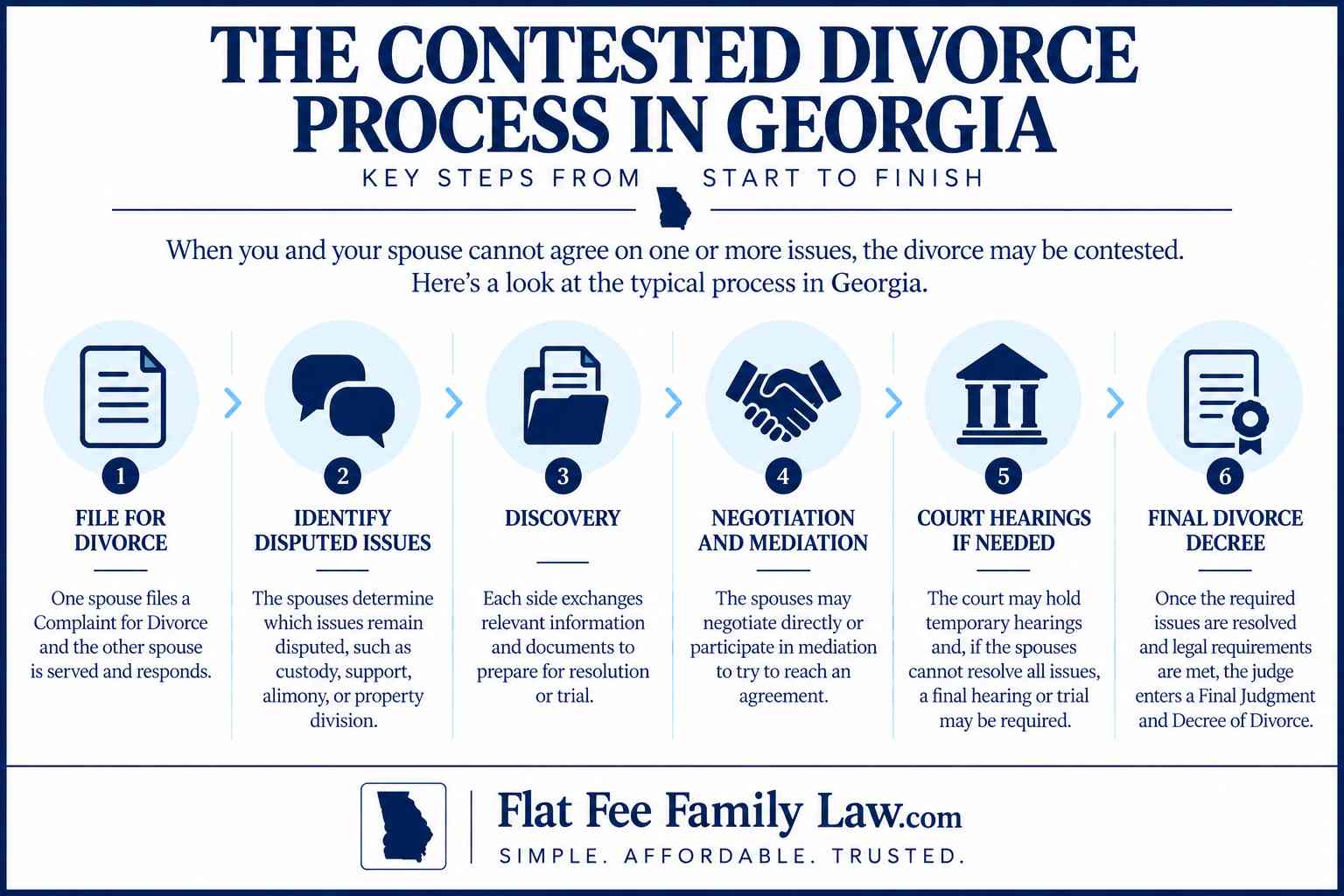
A contested divorce begins when one spouse files a Complaint for Divorce. The other spouse must generally be properly served and given an opportunity to respond. Once the case is underway, the issues that remain disputed begin to define what will need to happen before the divorce can be finalized. If you have been served with divorce papers, it is important to carefully review what your spouse is requesting rather than assuming the filing simply asks the court to grant a divorce.
What Happens During a Contested Divorce in Georgia?
Every case is different, but a contested divorce may involve several stages.
Identifying the Disputed Issues
Early in the case, it is important to determine what the spouses actually disagree about. For example, the dispute might primarily involve custody and parenting time. Another case might involve the division of a home, retirement accounts, or other assets. Clearly identifying those disagreements helps determine what information will be needed and which issues may require court involvement.
Temporary Orders
Some divorces involve issues that cannot reasonably wait until the case is finished. A court may be asked to enter temporary orders addressing matters such as custody, parenting time, child support, possession of the marital home, or other immediate concerns while the divorce remains pending. Temporary orders generally address how certain matters will be handled during the case rather than serving as the final resolution of the divorce.
Discovery
Discovery is the process through which the parties obtain information relevant to the case. Depending on the issues involved, discovery may include financial records, bank statements, tax returns, employment information, retirement-account information, property records, communications, or other relevant documents. Discovery can be particularly important when the spouses disagree about finances or when one party does not have complete information about marital assets or income.
Does a Contested Divorce Have to Go to Trial?
No. The fact that a divorce begins as contested does not necessarily mean it will end with a trial. Spouses can continue negotiating while the case is pending. They may resolve some issues while leaving others disputed. Mediation may also provide an opportunity to reach an agreement before trial.
If the spouses eventually resolve every issue, the case can generally move toward a final divorce without requiring the judge to decide those disputes at trial. If unresolved issues remain, however, the court may ultimately need to decide them.
What Happens at Mediation?
Mediation gives the spouses an opportunity to try to resolve disputed issues with the assistance of a neutral mediator. The mediator does not decide who should win. Instead, mediation provides a structured setting for the parties to explore possible agreements. Depending on the case, mediation may address:
- Custody and parenting schedules
- Child support
- Property division
- The marital home
- Retirement accounts
- Debts
- Other disputed issues
A successful mediation can resolve the entire divorce or narrow the number of issues that must ultimately be presented to the court.
What Happens If a Contested Divorce Goes to Trial?
If the spouses cannot resolve all disputed issues, the remaining matters may be presented to the court. At a final hearing or trial, each side may present testimony, documents, and other evidence relevant to the issues the judge must decide.
Depending on the case, the court may need to determine matters involving custody, parenting time, support, property division, or other unresolved issues. Once the court has resolved the necessary issues and the legal requirements for divorce have been satisfied, a Final Judgment and Decree of Divorce can be entered.
How Long Does a Contested Divorce Take in Georgia?
There is no single timeline that applies to every contested divorce. The length of a case can depend on factors such as:
- The number of disputed issues
- Whether custody is contested
- The complexity of the spouses’ finances
- The amount of discovery required
- Whether experts or additional evaluations are needed
- Whether the parties reach agreements during the case
- Mediation
- Court scheduling
- Whether the case ultimately requires a trial
A case involving one relatively narrow disagreement may proceed very differently from a divorce involving substantial assets and contested custody. For that reason, promises that a contested divorce will be completed within a particular amount of time should be viewed cautiously.
How Much Does a Contested Divorce Cost in Georgia?
The cost of a contested divorce depends heavily on how the legal representation is structured and how complicated the case becomes. Traditional divorce attorneys frequently bill by the hour. As a case requires additional correspondence, discovery, negotiations, hearings, mediation, or trial preparation, legal fees can increase.
Flat Fee Family Law uses flat-fee pricing for defined stages of representation rather than traditional hourly billing. The goal is to make the agreed legal fee for each stage clear before the work begins.
Do I Need a Lawyer for a Contested Divorce?
Georgia does not require every person going through a divorce to hire an attorney. But a contested divorce can involve court procedures, evidentiary issues, discovery, financial information, custody questions, settlement negotiations, and potentially a trial.
An attorney can help identify the issues that need to be addressed, explain the legal process, prepare court documents, evaluate settlement proposals, and represent a client when court appearances are necessary. That can be particularly important when the other spouse has an attorney or when significant parenting or financial issues are disputed.
What If We Reach an Agreement After Filing a Contested Divorce?
That happens frequently. A divorce that begins as contested does not have to remain contested throughout the entire case. The spouses may resolve disagreements through direct negotiations between their attorneys, mediation, or changes in circumstances that make an agreement possible.
If all remaining issues are resolved, the agreement can generally be documented and submitted as part of the process of finalizing the divorce. That is one reason it can be helpful to think of a Georgia divorce as a process rather than simply labeling the case “contested” or “uncontested.”
Preparing for a Contested Divorce
If you are considering filing for divorce or have already been served, start by identifying the issues that are likely to be disputed and gathering relevant documents. Depending on your case, useful information may include:
- Financial Information:
- Recent tax returns
- Pay stubs and income information
- Bank and investment statements
- Retirement-account statements
- Mortgage and property information
- Credit-card and debt statements
- Insurance information
- Documents concerning significant assets
- Information concerning the children’s schedules and needs
- Existing court orders
- Relevant communications between you and your spouse
Not every document will be important in every case. The information that matters depends on the particular issues that must be resolved.
Contested Divorce Representation in Georgia
A contested divorce can change considerably from the day it is filed until the day it is resolved. Issues that initially seem impossible to settle may ultimately be resolved through negotiation or mediation, while other disagreements may require a judge’s decision. The important thing is understanding what is actually disputed, what options are available for resolving those issues, and what each stage of the case may require.
Brendan Dalton represents clients in contested divorce cases throughout Georgia. Flat Fee Family Law uses flat-fee pricing for defined stages of representation, giving clients a clearer understanding of the agreed legal cost before moving forward. Schedule a call to learn more about how Flat Fee Family Law can help with your family law matter.
Frequently Asked Questions About Contested Divorce in Georgia
What makes a divorce contested in Georgia?
A divorce is contested when the spouses disagree about one or more issues that must be resolved before the divorce can be finalized. These may include custody, parenting time, child support, property division, or debts.
Can a contested divorce become uncontested?
Yes. If the spouses eventually reach an agreement on all remaining issues, a divorce that began as contested may be resolved by agreement rather than requiring the court to decide those disputes at trial.
Will I have to go to court?
Possibly. Court appearances may be necessary for temporary hearings, motions, or a final hearing. The particular requirements depend on the issues and circumstances of the case.
Can we settle after discovery begins?
Yes. Settlement discussions can occur throughout a divorce case. Information obtained during discovery may sometimes help the parties evaluate disputed issues and reach an agreement.
What happens if we cannot agree at mediation?
If mediation does not resolve every issue, the unresolved matters remain part of the case and may ultimately need to be decided by the court.
Is a contested divorce more expensive than an uncontested divorce?
It generally requires more legal work because there are unresolved issues. The ultimate cost depends on the complexity of the case, the amount of work required, and the attorney’s fee structure.