
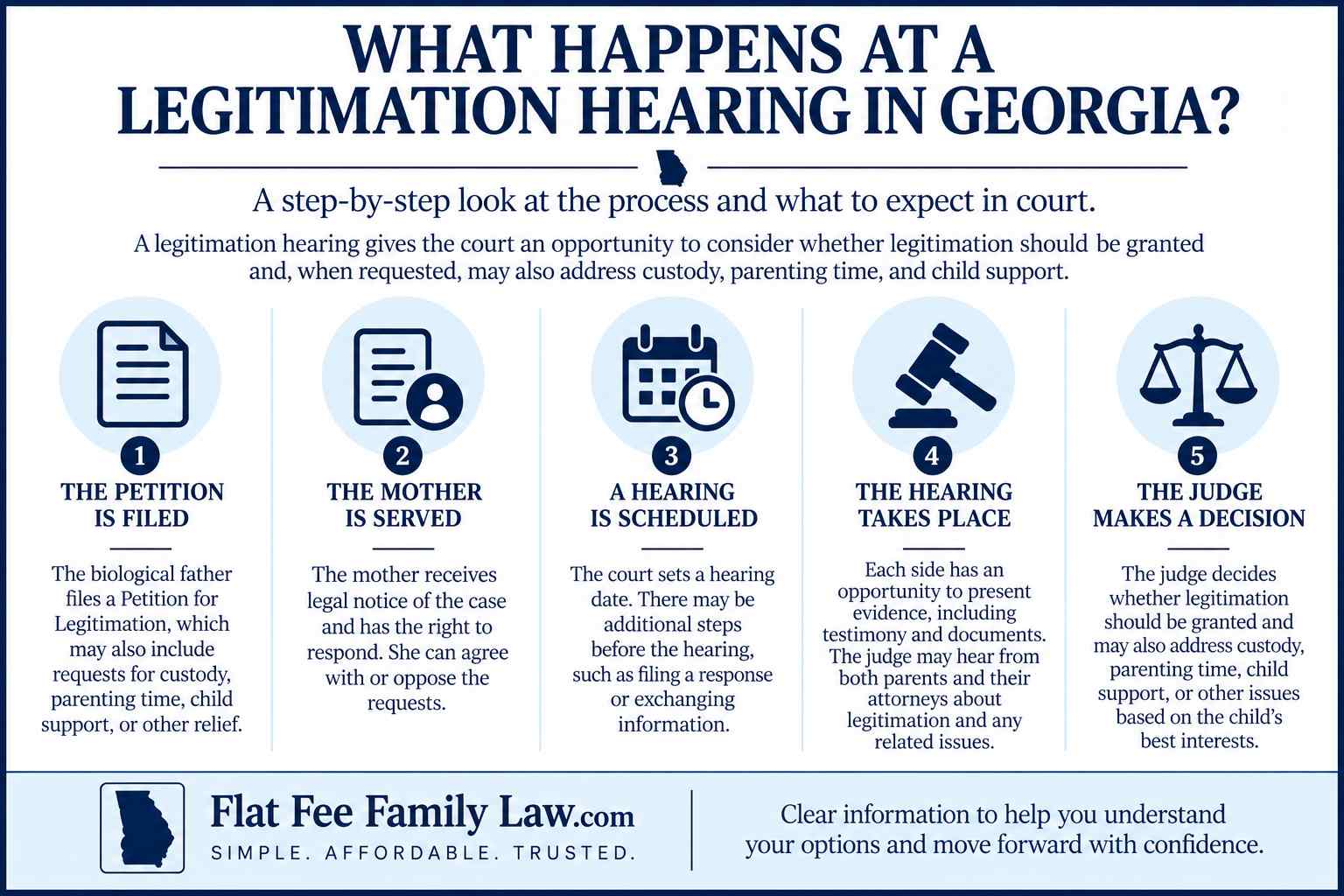
What Happens at a Legitimation Hearing in Georgia?
Being served with a legitimation case can raise immediate questions for a mother: What is the father asking the court to do? Does legitimation automatically give him custody or visitation? What happens at the hearing, and what can I tell the judge?
Fathers preparing for a legitimation hearing often have a different set of questions: What do I need to show the court? Will the judge decide parenting time at the same hearing? What happens if the mother opposes my petition?
A legitimation hearing in Georgia can address important legal rights involving a child whose parents were not married when the child was born. What happens at the hearing depends on what has been requested, whether the parents agree, and which issues the judge needs to decide. Understanding the purpose of the hearing—and the difference between legitimation, paternity, custody, and parenting time—can help both parents know what to expect.
What Is Legitimation in Georgia?
Under Georgia law, a biological father of a child born to unmarried parents may need to legitimate the child before he has enforceable parental rights involving custody or visitation. This is different from simply establishing paternity.
Being identified as the biological father, signing a birth certificate, or paying child support does not necessarily accomplish the same thing as obtaining an order of legitimation. Georgia Courts explains that, absent legitimation, the mother of a child born out of wedlock has custody, while the biological father may still have financial support obligations. A father seeking to establish legal rights may therefore file a Petition for Legitimation.
Why Is a Legitimation Hearing Necessary?
After a legitimation petition is filed, the mother must receive appropriate notice of the case and has an opportunity to participate. The court does not simply grant legitimation because a biological father asks for it. Georgia Courts’ current self-help materials explain that a father does not have an absolute right to have a legitimation petition granted and that the court considers whether legitimation is in the child’s best interests. Depending on the case, the court may also be asked to address:
- Custody
- Parenting time or visitation
- A parenting plan
- Child support
- The child’s name
- Other issues properly raised in the proceeding
A case in which the parents agree may look very different from one involving significant disputes over custody or parenting time.
What Happens at a Legitimation Hearing?
The exact procedure varies depending on the court, the judge, and the issues involved. Generally, the hearing gives each side an opportunity to present his or her position to the court. The judge may hear testimony, review documents, consider evidence, and hear legal arguments from the attorneys. If the parents agree about legitimation and the related parenting issues, the hearing may be relatively straightforward.
When the case is contested, the hearing may involve more substantial evidence concerning the father’s relationship with the child, the history between the parents, the child’s current circumstances, and any custody or parenting-time requests before the court. The judge then determines which orders should be entered based on best interests of the child.
What Should a Mother Expect at a Legitimation Hearing?
For mothers, one of the most important things to understand is that being served with a legitimation petition does not mean the father automatically receives the custody or parenting arrangement he requested.
Until a court enters an order addressing custody, Georgia law generally places custody of a child born to unmarried parents with the mother. A legitimation case can, however, create the opportunity for the father to seek legally enforceable custody or parenting time. That makes it important to look beyond the word legitimation and understand everything the father is actually requesting in the petition. For example, is he requesting:
- Legitimation only?
- Joint legal custody?
- Primary physical custody?
- A specific parenting schedule?
- Holiday or vacation time?
- A change to the child’s name?
- Other relief?
Those requests can have consequences that continue long after the legitimation case itself ends.
Can a Mother Oppose Legitimation?
A mother has the right to participate in the proceeding and respond to the father’s petition. There can be circumstances in which legitimation itself is contested. But a mother does not necessarily have to oppose legitimation itself simply because she disagrees with the father’s requested custody or parenting arrangement.
Those can be separate issues.
A mother might agree that the legal father-child relationship should be established while disagreeing strongly about the parenting schedule or custody arrangement the father is requesting. Understanding exactly what is disputed is therefore an important part of preparing for the hearing.
What Should a Father Expect at a Legitimation Hearing?
For fathers, filing the petition is only the beginning of the process. The fact that a man is the biological father does not mean the court is required to grant every request made in the case.
If the father is also requesting custody or parenting time, the court may need information concerning his relationship with the child and the parenting arrangement he believes would serve the child’s best interests. Depending on the circumstances, that may include evidence concerning:
- The father’s existing relationship with the child
- His past involvement in the child’s life
- His ability to provide appropriate care
- His knowledge of the child’s needs and routine
- His proposed parenting schedule
- Communication and cooperation between the parents
- The child’s school, medical, and extracurricular needs
- Other facts relevant to the custody issues before the court
A father who has signed the birth certificate, paid support, or maintained a relationship with the child should also understand that those facts do not by themselves substitute for a legitimation order.
Can Custody and Parenting Time Be Decided at the Legitimation Hearing?
Yes, when those claims are properly part of the case. This is one reason both mothers and fathers should pay close attention to what is actually requested in the pleadings.
A legitimation case may ultimately result in more than an order establishing the legal relationship between father and child. Depending on the claims presented, the court may also enter orders addressing custody and parenting time. A parenting plan may address issues such as:
- Regular weekday and weekend parenting time
- Holidays and school breaks
- Vacation time
- Transportation and exchanges
- Decision-making responsibilities
- Communication concerning the child
- Other practical parenting arrangements
The details can matter considerably once the court’s order is entered.
What About Child Support?
Child support and legitimation are related, but they are not the same legal issue. A biological father may have a duty to financially support his child even before obtaining enforceable custody or visitation rights. Conversely, paying child support does not by itself legitimate the child or create custody rights. When child support must be established or addressed, the parents’ financial information and the applicable Georgia child-support calculations may become important.
How Should You Prepare for a Legitimation Hearing?
Start by understanding the pleadings. A mother who has been served should review exactly what the father is asking the court to order. A father who filed the case should understand what he requested and what remains disputed. Before the hearing, it can also be helpful to:
- Review the petition and response
- Identify the issues that are actually disputed
- Gather relevant documents and evidence
- Understand any proposed parenting plan
- Organize financial information if child support is involved
- Identify potential witnesses when appropriate
- Review existing court orders involving the child
- Be prepared to explain the parenting arrangement you are requesting and why
Preparation should focus on the child and the legal issues before the court, rather than simply documenting every disagreement the parents have had with each other.
What Happens After a Legitimation Hearing?
The outcome depends on what the court was asked to decide. The judge may enter an order establishing the legal father-child relationship and, when appropriate, orders addressing custody, parenting time, support, or other matters properly before the court.
Once custody or parenting time is established by court order, both parents should understand what the order requires. A legitimation hearing therefore can be much more significant than simply establishing that someone is the child’s biological father. It may establish legal rights and parenting arrangements that affect the family for years.
Preparing for a Legitimation Hearing in Georgia
Whether you are a mother responding to a legitimation petition or a father seeking to establish legal rights to your child, it is important to understand what the court will actually be deciding. For mothers, that means understanding that a father’s petition may include requests for custody and parenting time in addition to legitimation. For fathers, it means understanding that biological paternity alone does not guarantee that the court will grant legitimation or a particular parenting arrangement.
Brendan Dalton represents both mothers and fathers across Georgia in legitimation cases. Flat Fee Family Law uses flat-fee representation so clients can understand the agreed cost of legal services before moving forward. Schedule a call to discuss your case and learn more about how Flat Fee Family Law can help.
Frequently Asked Questions About Legitimation Hearings in Georgia
Does the mother have to attend a legitimation hearing in Georgia?
The mother must be given appropriate notice of the legitimation proceeding and an opportunity to be heard. Whether a particular court requires a personal appearance can depend on the case, the issues involved, and the court’s instructions.
Can a mother fight a legitimation case in Georgia?
A mother may respond to and contest issues raised in a legitimation proceeding. The nature of the dispute matters: opposing legitimation itself is different from agreeing to legitimation while contesting custody or parenting time.
Does a father automatically get visitation after legitimation?
No particular visitation schedule automatically results from legitimation. A father may seek visitation or parenting time, and the court can address those requests based on the child’s best interests.
Is signing the birth certificate the same as legitimation in Georgia?
No. Signing a child’s birth certificate does not, by itself, constitute legitimation.
Is paying child support the same as legitimation?
No. A biological father can have a financial obligation to support a child without having established the legal parental rights associated with legitimation.