Who Is Responsible for Marital Debt After Divorce in Georgia?
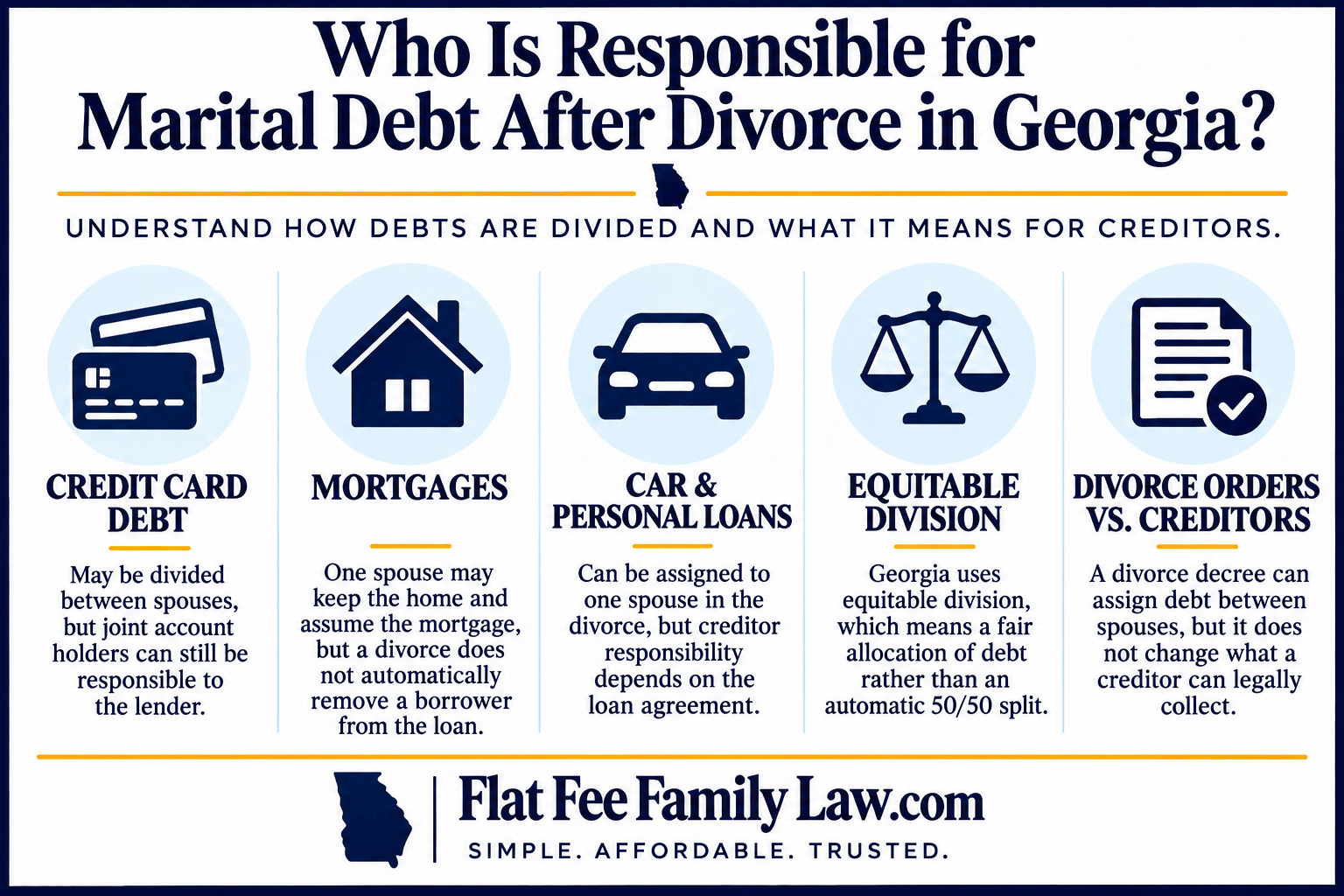
Dividing property is often one of the biggest financial concerns during a divorce, but what happens to the debts a couple accumulated during their marriage? Credit card balances, mortgages, car loans, personal loans, and other financial obligations can become significant sources of disagreement. In Georgia, marital debt may be divided between spouses as part of the divorce process. However, that does not necessarily mean each spouse pays half. Georgia follows principles of equitable division, meaning the goal is a fair allocation based on the circumstances rather than an automatic 50/50 split.
There is also an important distinction between what a divorce agreement requires and what a creditor can legally collect. Even when a divorce decree assigns responsibility for a debt to one spouse, the other spouse may remain liable to the lender. Understanding these differences before finalizing a divorce can help prevent unexpected financial obligations afterward.
What Is Considered Marital Debt in Georgia?
Marital debt generally includes financial obligations incurred during the marriage that are considered part of the marital financial relationship. Common examples include:
- Credit card balances accumulated during the marriage.
- Mortgages on marital property.
- Vehicle loans.
- Personal loans used for household expenses.
- Medical bills.
- Loans used for home improvements or family purchases.
- Other financial obligations incurred for marital purposes.
Not every debt incurred during a marriage is necessarily marital debt for purposes of equitable division. The circumstances surrounding the obligation can matter, including when it arose, why it was incurred, and how the borrowed money was used.
For example, a personal loan used to renovate the marital home may be evaluated differently from a debt incurred for one spouse’s unrelated personal expenses. Determining which debts should be addressed in a divorce requires examining the financial circumstances of the marriage rather than simply looking at account balances.
How Is Marital Debt Divided in a Georgia Divorce?
Georgia uses equitable division principles when allocating marital assets and liabilities. Equitable does not necessarily mean equal. A court may assign different financial obligations to each spouse based on the evidence and circumstances. A court’s allocation of marital debt determines responsibility between the spouses, but it does not necessarily change which borrowers remain legally responsible to the creditor. Relevant considerations may include:
- When the debt was incurred.
- The purpose of the debt.
- Whether the obligation benefited the marriage or household.
- Each spouse’s financial circumstances.
- The relationship between the debt and the marital assets being divided.
- Other circumstances relevant to a fair division.
For example, one spouse may receive the marital home and agree to assume responsibility for the mortgage. Another spouse may take responsibility for certain credit card balances or vehicle loans. The division of debt may also be negotiated alongside the division of property. A settlement that assigns more debt to one spouse might account for other assets that spouse receives. If the spouses cannot agree, the court may need to resolve the disputed financial issues.
Is Each Spouse Responsible for Half of the Marital Debt?
Not automatically.
Georgia does not require every marital debt to be divided equally simply because it arose during the marriage. Consider a couple with $30,000 in credit card debt and a $20,000 vehicle loan. One spouse might agree to take responsibility for the vehicle loan while the other assumes the credit card debt. Alternatively, the spouses may negotiate a different arrangement that accounts for their incomes, assets, and other financial obligations.
If the case is contested, the court may determine how responsibility should be allocated. The important question is not necessarily whether each spouse pays exactly half, but whether the division is appropriate under Georgia law and the circumstances of the marriage.
Who Pays Credit Card Debt After Divorce in Georgia?
Credit card debt can be particularly complicated because the account holder and the person responsible for paying the debt under a divorce agreement may not be the same. Consider two common situations.
Joint Credit Card Accounts
If both spouses are contractually responsible for a credit card account, the creditor may generally seek payment from either spouse, even if the divorce decree assigns the balance to only one of them. For example, a divorce agreement may require one spouse to pay a $12,000 joint credit card balance.
If that spouse stops making payments, the credit card company may still pursue the other spouse if both remain legally responsible for the account. The divorce agreement establishes obligations between the former spouses, but it does not automatically change the creditor’s contractual rights.
Credit Cards in One Spouse’s Name
A credit card account held in one spouse’s name may still involve debt considered marital for divorce purposes. For example, a spouse might have used an individually held credit card to pay household bills, purchase furniture, or cover family expenses during the marriage.
The divorce court may consider that debt when dividing the marital financial obligations. However, the fact that a debt is treated as marital does not automatically make a spouse who never agreed to the credit account personally liable to the creditor. This distinction is important: responsibility under a divorce order and liability under a credit agreement are separate legal questions.
Can You Be Responsible for Debt That Is Only in Your Spouse’s Name?
Potentially, for purposes of the divorce settlement or court-ordered division. The name appearing on an account is not always the deciding factor when a Georgia court evaluates marital debt. For example, suppose one spouse obtained a personal loan during the marriage to pay for improvements to a jointly used home. Although only that spouse signed the loan agreement, the obligation may still be considered when the marital finances are divided.
A court may allocate responsibility for the debt as part of the divorce. That does not necessarily mean the lender can collect directly from a spouse who never signed the loan or otherwise became legally obligated. The purpose of the loan, the applicable agreements, and the surrounding circumstances all matter.
What Happens to Debt You Had Before Getting Married?
Debt incurred before marriage is generally treated differently from debt accumulated during the marriage. For example, if one spouse entered the marriage with an existing credit card balance or personal loan, that obligation may remain separate rather than being divided as marital debt.
However, the analysis can become more complicated when financial arrangements change during the marriage. Spouses may refinance an existing obligation, jointly assume responsibility for a loan, or use marital resources to pay down separate debts. These circumstances can affect the overall financial analysis. Before assuming that a particular obligation is separate, it is important to review the loan documents, account history, and how the debt was handled during the marriage.
Who Is Responsible for the Mortgage After Divorce?
Mortgage obligations present a particularly important issue because ownership of the home and responsibility for the mortgage are not necessarily the same thing. For example, a divorce settlement may provide that one spouse keeps the marital home and assumes responsibility for making the mortgage payments.
However, if both spouses signed the mortgage loan, both may remain liable to the lender unless the loan is refinanced, paid off, or the lender otherwise releases a borrower. Transferring ownership of the property does not automatically remove a spouse from the mortgage. This can create financial risk if the spouse keeping the home stops making payments. Depending on the circumstances, possible settlement arrangements may involve:
- Selling the home and paying off the mortgage.
- Refinancing the loan into one spouse’s name.
- Establishing deadlines for refinancing or selling.
- Addressing responsibility for mortgage payments while the property remains jointly financed.
These arrangements should be carefully evaluated before the divorce agreement is finalized
What Happens to Personal Loans and Car Loans in a Divorce?
Personal loans and vehicle loans may also need to be addressed in the division of marital finances. For a vehicle loan, the spouses may agree that the person keeping the vehicle will also assume responsibility for the remaining balance. However, if both spouses are borrowers, the lender’s rights generally remain governed by the loan agreement.
Similarly, a personal loan used for marital expenses may be allocated between spouses even if only one originally obtained the financing. The divorce agreement should identify which spouse is responsible for payments and address any necessary steps to refinance, pay off, or otherwise resolve shared obligations. Simply stating that one spouse will pay a debt may not eliminate the other spouse’s exposure to the creditor.
Does a Divorce Decree Protect You From Creditors?
Not necessarily, and this is one of the most important issues to understand when dividing marital debt. A Georgia divorce decree can establish which spouse must pay a particular obligation. However, creditors are generally not parties to the divorce proceeding. As a result, a divorce court cannot ordinarily eliminate a creditor’s existing contractual rights simply by assigning the debt to one spouse.
Consider this example:
- A couple has a joint credit card with a $15,000 balance.
- Their divorce decree requires the husband to pay the entire balance.
- Six months later, he stops making payments.
If the wife remains contractually responsible for the account, the credit card company may still seek payment from her despite the divorce decree. She may have legal remedies against her former husband for failing to comply with the court order, but those remedies do not necessarily prevent the creditor from pursuing collection. This is why the terms of a divorce settlement should address not only who is supposed to pay a debt, but also how the parties will manage continuing joint financial obligations.
What if Your Ex-Spouse Refuses to Pay Debt Assigned in the Divorce?
If a final divorce decree requires one spouse to pay a debt and that spouse fails to comply, the other spouse may have options for seeking enforcement. Depending on the terms of the decree and the nature of the obligation, enforcement may involve a motion for contempt or other appropriate court proceedings. Not every debt-related obligation is enforceable through the same remedy.
However, enforcement proceedings between former spouses do not automatically stop a creditor from pursuing someone who remains legally liable for the debt. For example, if your former spouse was ordered to make payments on a joint loan but fails to do so, you may need to address both the creditor’s collection efforts and the failure to comply with the divorce decree. The available remedies depend on the specific provisions of the judgment and applicable law.
How Can You Protect Yourself From Marital Debt During Divorce?
Before signing a divorce settlement agreement, it is important to understand all outstanding financial obligations and how the proposed division will work in practice. Consider the following steps:
- Identify all outstanding debts, including credit cards, mortgages, personal loans, vehicle loans, and other obligations.
- Review account statements and loan agreements to determine whose names appear on each obligation.
- Determine whether the debts were incurred before or during the marriage and how the funds were used.
- Discuss whether joint accounts can be paid off, closed, or refinanced as part of the settlement.
- Make sure the agreement clearly identifies responsibility for each debt and addresses how shared obligations will be handled.
It is also important to review the relationship between the debt division and the overall property settlement. For example, an agreement that appears fair based only on the value of assets may look very different once outstanding mortgages, loans, and other liabilities are considered. An attorney can help evaluate these issues and explain the legal consequences of the proposed agreement.
Can Spouses Agree on Debt Division in an Uncontested Divorce?
Yes. Spouses who agree on the division of marital debt may include those terms in their divorce settlement agreement. An uncontested divorce in Georgia generally requires the spouses to resolve the issues necessary to finalize their case, including the allocation of marital property and financial obligations. For example, spouses may agree that:
- Each will pay certain credit card balances.
- One spouse will retain a vehicle and assume its loan.
- The marital home will be sold and the mortgage paid from the proceeds.
- Particular personal loans will be assigned to one spouse.
These arrangements should be clearly documented, particularly when a debt involves both spouses. Even when spouses agree on who will pay a debt, they should understand that the settlement does not automatically change the lender’s rights. If the parties cannot agree on how debts should be allocated, the dispute may need to be resolved through negotiation, mediation, or contested divorce proceedings.
Divorce Representation for Financial Disputes in Georgia
Disagreements about marital debt can affect a couple’s financial stability long after their divorce is finalized. At Flat Fee Family Law, Brendan Dalton represents clients throughout Georgia in both uncontested and contested divorce cases, helping them understand the financial and legal issues involved in reaching a settlement or resolving disputed matters. Our flat-fee divorce representation includes:
- Uncontested Divorce — $2,000, including standard filing fees.
- Full-Case Divorce Representation — $3,500 to respond to a divorce petition or $4,200 to file.
Our full-case representation covers attorney services through completion of the agreed case, including negotiations, settlement discussions, and court proceedings as needed. Certain third-party expenses are excluded as described in the service agreement. Clients work directly with Brendan and know their attorney fees before representation begins.
No retainers. No hourly billing. No surprises.
If you are considering divorce and have questions about responsibility for credit cards, mortgages, personal loans, or other marital debt, schedule a consultation with Flat Fee Family Law to discuss your circumstances and legal options.
Frequently Asked Questions About Marital Debt After Divorce in Georgia
Is marital debt automatically split 50/50 in a Georgia divorce?
No. Georgia follows equitable division principles, meaning marital debt is allocated based on the circumstances rather than automatically divided equally. The spouses may agree on an allocation, or the court may resolve disputed financial obligations.
Can I be responsible for my spouse's credit card debt in Georgia?
Potentially. Credit card debt incurred during the marriage may be considered marital debt for purposes of the divorce, even if the account is in one spouse’s name. However, responsibility under a divorce decree is different from liability to the credit card company.
If my spouse is ordered to pay a joint debt, am I still responsible?
You may be. If you remain contractually responsible for a joint account, the creditor may still pursue payment from you even if your divorce decree requires your former spouse to pay the balance.
Does divorce remove my name from a mortgage or car loan?
No. A divorce decree does not automatically remove a borrower from a loan. Refinancing, repayment, or an agreement with the lender may be necessary to release a spouse from the obligation.
What happens if my ex-spouse does not pay a debt assigned in our divorce?
You may be able to seek enforcement of the divorce decree through the court. However, a creditor may still pursue you if you remain legally liable for the debt. The available remedies depend on the order and circumstances.
Is debt incurred before marriage considered marital debt?
Debt incurred before marriage is generally treated as separate, but later financial arrangements can complicate the analysis. Refinancing, joint borrowing, and other circumstances may affect how the obligation is addressed.
Can we divide marital debt without going to court for a trial?
Yes. Spouses may negotiate and document an agreed division of marital debts in a settlement agreement. When all necessary divorce issues are resolved, the case may proceed as an uncontested divorce, subject to court approval.